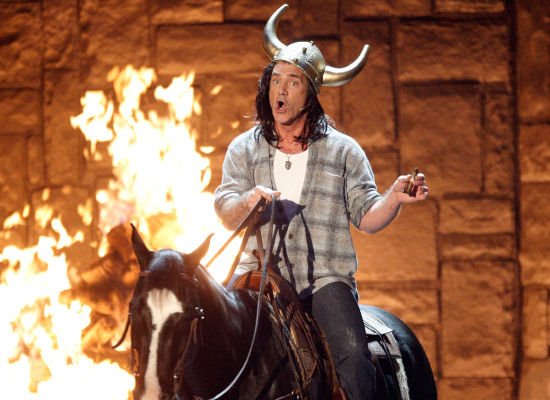
 So apparently Mel Gibson is taking career advice from Sean Penn and Christian Bale. We've read the stories about how he said racist things and verbally abused his ex squeeze Oksana Grigorieva but now we finally have the audio. It's strange that a man who rose to stardom because of his natural likability and boyish charm could be so cold and oppressive to this woman. On the plus side, I really like at the end when he says she can stay in the house. He's not giving it to her, but she can stay. Way to be the bigger man Mel.
Saturday, July 10, 2010
Celebrities Behaving Badly
So apparently Mel Gibson is taking career advice from Sean Penn and Christian Bale. We've read the stories about how he said racist things and verbally abused his ex squeeze Oksana Grigorieva but now we finally have the audio. It's strange that a man who rose to stardom because of his natural likability and boyish charm could be so cold and oppressive to this woman. On the plus side, I really like at the end when he says she can stay in the house. He's not giving it to her, but she can stay. Way to be the bigger man Mel.
Tuesday, July 6, 2010
Am I Missing Something?

Here's a funny question for someone who is more well versed on the subject than I. I was reading Roger Ebert's review for Twilight:Eclipse and he made a comment about the tent scene between Edward and Jacob. It was in jest, but Ebert made reference to Brokeback Mountain.
Then I was looking at IMDB to see who would be directing the fourth film and saw that it was Bill Condon, an openly gay man. I then saw in the trivia section that at one point Gus Van Sant, another openly gay man, had been in talks to also direct the fourth film. Considering that both of these men's films, if not dealing with gay characters, have homosexula undercurrents running through them, is there something inherently homosexual about Breaking Dawn or Twilight as a whole? Is it in the books? I think there could be an interesting reading here, but I don't think I'm expert enough on the Twilight universe to give it.
Any thoughts?
The Celebirty Connection-Six Feet Under
I don't really watch TV but in grade 12 I discovered Six Feet Under and was hooked. I watched every episode of the first season. Too bad that by the time Season 2 came to Canada on a channel that didn't require a subscription I was living in a TV-less university dorm. Over the years I have picked up all five seasons on DVD but have only started rewatching them now. I just got through the entirety of the first season again and will be moving on to the second soon. However, I noticed something about the artwork:


Is the cover art for The Black Dahlia just the cover art for Six Feet Under in disguise? You Decide.
Monday, July 5, 2010
Filmic Measures-The Documentary Rule
 When Gene Siskel said that a movie needed to be better than having lunch with its stars he, in a way, unconsciously, if not changed film criticism, than changed the way films are consumed. Although the statement was, I assume, meant merely as a means to have a quotable critical means for which to evaluate movies, the buried implications are worth unearthing. To think about films this way is to uncover their relationship to the world or art, society, etc, for a film, in order to succeed, must always be better than something else. Is there another art that bears such a burden? Theatre is comparable to other theatre, music is judged based on it's worth next to other music and the success of the writer depends on their ability to convey meaningful thoughts through words.
But film is at once art, culture, politics, philosophy, psychology, engineering, anthropology, history, sociology, what have you. And although all art is, in some way, influenced by these things, does any but film ever truly embody them? For most arts have something that keep art separated, for lack of better phrasing, from politics. The play has the luxury of unfolding in real time in front of a crowd in which, if one desired, could be reached out and touched, but it is, aesthetically speaking, built upon the suspension of disbelief. The writer is not so much responsible for the events they depict as they are their interpretation of such events, which are only as real as the writer's negotiation of them. The writer has poetry on their side. But, because of this disconnection, theater must only be better than other theatre, the novel only better than other novels, etc.
But film, despite the "lie" of editing as Godard would have it, is captured with sound, movement, colour. It's a literal embodiment of whatever has been placed before the camera, no matter how artificial it's construction may have been. Film must not only be art, politics, philosophy, etc., it must be better than art, politics, philosophy, etc.
That's why we're always judging film based not only reality, believability, aesthetic invention and so on, but also the depth of it's thoughts, it's moral centre, it's ability to speak something, anything, be it the banal or the humorous. To paraphrase what Ossie Davis once said: art is a form of power; it has the ability to move us and make us move. Is there, looking back on history, a more powerful art form, in this sense, than film?
That's why we create these sayings, these filmic measures because, as Siskel pointed to us, all film must be better than something else. So here's one: A film must be better than a documentary made on the same subject. The difference between fiction and documentary is simple: documentary is fact, fiction is being there (note-I am using fact in an abstract way, not in a literal way as if to suggest that documentaries are not subjective). A fiction film should take you to the heart of it's subject, take you along for its journey, let you understand its hero and their cause, morals, beliefs, whatever it is that makes the experience as personal and intimate as possible. A documentary on the other hand should be, as it's name suggests, a document of something; a chronicling of a belief, a movement, a moment in time. Fiction is built from emotions. Documentary is, in one way or another, built from thesis'.
That's why a fiction film needs to be better. It needs to, in a sense be more real, because it needs to immerse the viewer. Documentaries impact knowledge and feelings. Fiction does this too, but also takes you for a ride. Take a real example: Werner Herzog's Rescue Dawn is based on the story of Dieter Dengler, the subject of Herzog's documentary Little Dieter Needs to Fly. Although Little Dieter is a special and informative documentary, Rescue Dawn shows us what Little Dieter can only leave in the crevices of our imagination. It makes the story more real by putting us alongside Dengler in that moment.
Some films are so boring and so dramatically uninspired that to see a documentary on the same subject would be so much more enlightening, entertaining, informative, whatever. The September Issue must certainly be of more worth than either Sex and the City movie, no? That's because the documentary tells us something about high class, sophistication, fashion, and so on, where the film simply uses that world in order to fulfill it's own superficial fantasies and fairy tales. You see the difference?
Other Filmic Measures: The Chocolate Bar Movie, Where's The Airship Movies
Celebrities Behaving Badly
I haven't done one of these since Sean Penn decided to take a swing at someone at an Oscar party, so either I've been going blind or today's celebrities just aren't made like they used to be.
Anyway, it sees that there are three things that can happen to a comedian once they hit big time fame. They can either 1) get lazy and recycle the same tired act over and over again (Dane Cook), 2) they can hone their material, build an audience and continue to grow and evolve because they are naturally gifted at what they do and take it seriously as an art form (George Carlin, Richard Pryor, Louis C.K.) or 3) they can go nuts. Remember this picture:
 This surfaced sometime between Katt Williams skyrocketing to superstar status, being thrown in a loony bin after causing a scene in a hotel lobby wearing nothing but a bathrobe and being arrested for allegedly breaking into a house and holding a kid hostage against his will.
Apparently Dave Chapelle, who also found stardom and disappeared because of it, apparently wants to follow in Katt's footsteps as TMZ reports that a private jet needed to make an emergency landing after Chappelle lost his mind on board and was considered to be a safety risk.
I hate to assume, but suspect that both of these men have found this path due to drug use, which isn't exactly strange in the comedy world. Pryor got arrested for killing his car and almost died from blowing up while free-basing cocaine but some of the greatest bits in comedy history were born from those experiences. Sadly, it seems that these two guys just couldn't handle the pressure and will probably soon fade into obscurity if such isn't already the case.
Anyway, it sees that there are three things that can happen to a comedian once they hit big time fame. They can either 1) get lazy and recycle the same tired act over and over again (Dane Cook), 2) they can hone their material, build an audience and continue to grow and evolve because they are naturally gifted at what they do and take it seriously as an art form (George Carlin, Richard Pryor, Louis C.K.) or 3) they can go nuts. Remember this picture:
This surfaced sometime between Katt Williams skyrocketing to superstar status, being thrown in a loony bin after causing a scene in a hotel lobby wearing nothing but a bathrobe and being arrested for allegedly breaking into a house and holding a kid hostage against his will.Apparently Dave Chapelle, who also found stardom and disappeared because of it, apparently wants to follow in Katt's footsteps as TMZ reports that a private jet needed to make an emergency landing after Chappelle lost his mind on board and was considered to be a safety risk.
I hate to assume, but suspect that both of these men have found this path due to drug use, which isn't exactly strange in the comedy world. Pryor got arrested for killing his car and almost died from blowing up while free-basing cocaine but some of the greatest bits in comedy history were born from those experiences. Sadly, it seems that these two guys just couldn't handle the pressure and will probably soon fade into obscurity if such isn't already the case.
Thursday, July 1, 2010
Celebrity Connection The Twilight Edition: Dr. Carlisle Cullen


Twilight: Eclipse (1.5 out of 5)
 The Cullens must just about be one of the most understanding families in all of cinema. Not only do they like their son Edward’s girlfriend Bella Swan (Kristen Stewart), but they also accept her mortality and dedicate their entire effort as a family unit to protecting her against other vampires who want nothing but to make lunch of her to the point where they even make a pact with their enemies eternal, the werewolves, in order to help fiend these baddies off of poor Bella. At a certain point, when the family risks danger and disownment by betraying some sort of unspoken vampire code in order to fend for this girl, didn’t one of the elder Cullens ever think, hey, maybe our son could do better?
The werewolves, of course, also have reason to band together with the vampires because, well A) they don’t like vampires and the chance to kill some without breaking their ancient treaty is mighty appealing, but also because B) one of them, Jacob (Taylor Lautner) is kind of in love with Bella as well, in which case, in order for this story to work, Bella Swan would just about need to not only be the best thing since sliced bread, she’d also have to put that legacy into question. Certainly Bella, if worthy of these male pursuits, could, among other things, slice a loaf of bread or two, couldn’t she?
But the thing is, Bella’s nothing really that special. She’s a pale, skinny kid in blue jeans and a hoodie. I’m sure she’s a nice girl, but certainly not the type that would take your breath away after 100 of years of meeting cute high school girls. In fact, what comes out in David Slade’s Twilight: Eclipse, the third in the series, is that she’s kind of selfish and stupid. There’s a scene where she goes to visit her mother in Florida early in the film because, after graduation, she intends to become a vampire, marry Edward (Robert Pattinson) and never be heard from again. For a graduation gift mom gives Bella a quilt stitched together from all the T-shirts she got from their travels, to which she also chimes in that hopefully they can ad many more in the future. You realize here exactly what Bella wants to give up and have to wonder, why? She basically wants to give up the rest of her life for what symbolically comes down to sex. Unless of course Edward Cullen is the greatest thing since...
It’s at this point that one realizes that the Twilight films have been missing everything that, as far as fad franchises go, has made the Harry Potter books/films so special for so many years. Part of the joy of Harry Potter was in kids exploring a world unknown to them and discovering things about themselves, abilities and powers, but also exploring how they related to the everyday woes of growing up. Harry may have fought giant snakes in the basement but that didn’t make the stress of asking a girl to the Yule Ball any easier.
There’s nothing like that in the Twilight series that grounds it in some sort of plausible reality and provides an entry point as a way to care about these characters or anything that happens to them. Bella broods, Edward mopes, Jacob snarls and both men try to convince the emotionally confused Bella that their love is the best for her. And then Bella contemplates this, and changes her mind, and then changes it back, and then is mad at Edward, but then still likes him more, as the story, over the course of three books/films, still pretends to build to some important event that always feels just over the horizon but never manages to happen. The only difference between Eclipse and it’s predecessors Twilight and New Moon is that in this one, for fifteen minutes or so towards the end, something actually happens.
Did Stephenie Meyer really expand all this confusion, moping, assessing and reassessing over the entire span of three books? Has Hollywood really dedicated six hours to introducing these characters while they shuffle around in self pity while absolutely nothing even close to resembling drama ever comes close to happening? If Meyer wasn’t as incompetent a writer as she is, she would surely know that each work, although belonging to a singular network that propels the same story forward, needs to be self-sufficient as a complete whole insomuch as that, when it ends, the audience feels content in knowing that this chuck of the story is over and has passed through something even so slightly as resembling a beginning, middle and end. Instead Meyer and painfully faithful screenwriter Melissa Rosenberg are trickless magicians; always pulling air out of empty top hats. When the credits role over the close of Eclipse you get to thinking: oh great, now I have to wait for the next film for the action to actually start rolling.
You can’t blame any of this on the film’s players. They are, after all, working with source material about as awful as any there has ever been. Director David Slade (30 Days of Night) throws away the autumn hue of Chris Weitz’s New Moon in order for a darker, more murky look without returning to the ugly blue tint of Catherine Hardwick’s original Twilight film and also provides a climatic battle which is only the second most incomprehensible action sequence this summer. Stewart and Pattinson are about as good as they have been any other time, filling the role while making you realize they probably deserve much better, Dakota Fanning, still in cameo mode, shows up to assert why she probably isn’t the best choice to play villains and Lautner is still giving the kind of self-important performance that only a truly terrible actor can give when they fail to realize how bad they are playing.
And that’s it. The story will continue in 2011 when Bill Condon, the series’ most prestigious director takes a stab at the fourth and final chapter, in which maybe something will actually happen, although, considering the film will but cut into two parts, it’s unlikely that we’ll be seeing any life (no pun intended) from this franchise until 2012. Although, at this point, I think Edward and Jacob should cut their loses, find one of their own kind and let Bella realize that having a boyfriend when you’re in high school shouldn’t really be this much work.
Did Stephenie Meyer really expand all this confusion, moping, assessing and reassessing over the entire span of three books? Has Hollywood really dedicated six hours to introducing these characters while they shuffle around in self pity while absolutely nothing even close to resembling drama ever comes close to happening? If Meyer wasn’t as incompetent a writer as she is, she would surely know that each work, although belonging to a singular network that propels the same story forward, needs to be self-sufficient as a complete whole insomuch as that, when it ends, the audience feels content in knowing that this chuck of the story is over and has passed through something even so slightly as resembling a beginning, middle and end. Instead Meyer and painfully faithful screenwriter Melissa Rosenberg are trickless magicians; always pulling air out of empty top hats. When the credits role over the close of Eclipse you get to thinking: oh great, now I have to wait for the next film for the action to actually start rolling.
You can’t blame any of this on the film’s players. They are, after all, working with source material about as awful as any there has ever been. Director David Slade (30 Days of Night) throws away the autumn hue of Chris Weitz’s New Moon in order for a darker, more murky look without returning to the ugly blue tint of Catherine Hardwick’s original Twilight film and also provides a climatic battle which is only the second most incomprehensible action sequence this summer. Stewart and Pattinson are about as good as they have been any other time, filling the role while making you realize they probably deserve much better, Dakota Fanning, still in cameo mode, shows up to assert why she probably isn’t the best choice to play villains and Lautner is still giving the kind of self-important performance that only a truly terrible actor can give when they fail to realize how bad they are playing.
And that’s it. The story will continue in 2011 when Bill Condon, the series’ most prestigious director takes a stab at the fourth and final chapter, in which maybe something will actually happen, although, considering the film will but cut into two parts, it’s unlikely that we’ll be seeing any life (no pun intended) from this franchise until 2012. Although, at this point, I think Edward and Jacob should cut their loses, find one of their own kind and let Bella realize that having a boyfriend when you’re in high school shouldn’t really be this much work.
Subscribe to:
Posts (Atom)