Tuesday, September 14, 2010

TIFF Red Carpets: Stone

There was a big decision to make Friday night. It was either stick around outside Roy Thompson Hall to catch a glimpse of Clive Owen and David Schwimmer for Trust or head over to the Visa Screening Room to check out the Stone Red Carpet. Having never been to the Elgin, we decided Goodfellas trumps Friends so we headed for Elgin.


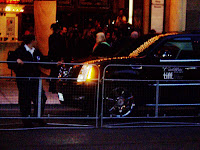
The first thing to say about Elgin is that it sucks. I haven't been to the Ryseron theatre so I have no idea if it is worse than this one, but this is pretty bad. You stand across the road on the Yonge St. sidewalk until cars start pulling up and then everyone runs for the barricades. 20 minutes later was when the cops decided it was time to close the road and as a general rule, most stars get out of the car on the right side towards the entrance and not the left towards the crowd and head right for the press. Unfortunately I was using my girlfriend's camera which is about 5 years old and doesn't take good pictures in the dark. I'll do better next year.

Unbeknownst to me, we really weren't prepared on Friday, Beautiful was playing at 8:00 at Winter Garden (which is in the same building as Elgin). So somewhere in that crowd is Javier Bardem.

To be quite honest, at the time I knew nothing about Stone other than that De Niro was in it and Edward Norton had a goatee, and as a general rule, Norton's best movies are the ones where his character sports the goatee. Therefore I had no idea Milla Jovovich was in it or that it was she I was taking a picture of.

Edward Norton has a reputation of being difficult to work with but that didn't stop him from coming over to the road and signing autographs/shaking hands. He didn't do it for long but he seemed like a stand-up guy.

Edward and Milla. Unfortunately De Niro showed up 20 minutes late after they had already let the audience in. He turned and waved for a second and then rushed inside before his car had even gotten out of the way. No good pictures of him were captured

As an added bonus, Roger Ebert stopped for fans on Saturday afternoon as his cab pulled out of the Four Seasons. Here he is hoping his new show is a success.

Monday, September 13, 2010

TIFF Red Carpets: The King`s Speech

I've been dormant for too long. I have half a Going the Distance review to still write but I've been spending almost all of my time downtown since last Thursday. I'm not a festival guy. I didn`t get caught up in reporting on the Toronto International Film Festival because I don`t have time or money to go see the movies. Instead, what I care about is going and standing on the red carpets and getting a glimpse of the stars. I can see the movies in theaters when they come out, but really, when can I tell Darren Aronofsky that he`s the next Scorsese to his face. That`s where the magic is anyway. There`s a feeling of excitement as stars pull up in those black Cadillacs, guessing who it could be, hoping to get an autograph before they are whisked away to the press by their publicists.


So anyway, over the next couple of days I will be posting pictures and telling stories from the red carpet. If you want actual coverage of the fest go check out Mad Hatter at The Dark in the Matinee who is making the rounds, or Black Sheep Reviews where Joseph got accepted to be on the You Will Meet a Tall Dark Stranger red carpet. But if you want pictures of the stars, well darlings, I have them.


The first thing that is shocking about seeing any celebrity is the realization that they are not all ten feet tall. I always expected Geoffry Rush to be a tall guy. He`s quite the opposite actually. This was my first red carpet ever. We came unprepared without anything to sign so this one was fairly tame for us. The King`s Speech is an interesting title for me because I have read the script and enjoyed it very much.


Rush again. At this point I`m already feeling start struck. A new obsession is growing.

I have no idea what her name is, but this is Colin Firth`s wife.

The man of the hour arrives. There was debate about whether Colin Firth would come sign autographs or not because he`s generally low-key at these kinds of things and no one really knew if he was a jerk or not. He disappeared for a moment and then reappeared after the crowd started signing Happy Birthday to him. He was very polite and very British.

There`s the money shot.

Tuesday, September 7, 2010

I Don't Know?


There's apparently a bet going on in the make-up department to see who can make Sean Penn look the stupidest before he starts throwing punches. To Penn's credit he has the poise of a true professional: holding a completely serious look while looking like a complete boob. Come to think of it he kind of looks like my grandmother.

Monday, September 6, 2010

One Minute Review - Boondock Saints 2 (ZERO)


Troy Duffy represents the quintessential indie film story: a young, cocky filmmaker whose number one fan is himself, with a collection of everyone else's ideas in his head, alienates just about everybody around him and more or less destroys himself on the blind path to making a truly terrible movie.

There was a great documentary made about it called Overnight, which chronicled Duffy's rise and fall. He was so confident in himself that he commissioned some friends to follow him around with a camera as he was making the original Boondock Saints so that they could see a masterpiece in the making. However the guys are no longer friends, the documentary tells the tale, The Boondock Saints sucked and the sequel is ever worse.

The legend is that Duffy, a near alcoholic musician and bar owner signed with the William Morris Agency and cut a deal with Harvey Weinstein to make his directorial debut, a foul mouthed crime tale of two Irish guys in Boston who kill in the name of the Lord. Weinstein said he'd pay for the picture, buy the bar, sign the band, whatever. However Weinstein, by that time, was known to be an infamous reneger but Duffy still didn't take the hint when the man never returned his calls.

Alas the Boondock Saints was finally made, grossed nothing and inexplicably became a huge hit on DVD; enough to justify this sequel which is loud, over-stylized, stupid, vulgar, unfunny, racist, homophobic and doesn't even begin to make sense. Duffy still riffs on Tarantino's cred as if he can out-hip the master while never once fully realizing what makes Quinten a true original. I just finished reading an invaluable book by David Mamet entitled On Directing Film in which Mamet muses, to simplify the concept, that great writing and direction breaks things down into their simplest form and uses shots to tell the story. If it doesn't contribute to the story of the character achieving their desired end, throw it out because it's useless. It's advice Duffy could have used although, in that case, he'd be without a film.


Sunday, September 5, 2010

Long Overdue Celebrity Connection: Andrew Keegan

If you don't know who Andrew Keegan is, well, neither do I, but in the comments section for my last Celebrity Connection, one of my favourite followers, Meaghan from Wild Celtic suggested I do one of Keegan, one of her favourite hotties. As the summer is basically over and Meaghan has gone off to the U.K. to study (where I wish her all the best) I figured now is the perfect time to grant her that wish. So Meagahn, here ya go:

Could Andrew Keegan (who was in 10 Things I Hate About You by the way) just be Mario Lopez in disguise? You decide.

The Box (4 out of 5), Or How I Learned to Stop Worring amd Learned what a Kubrickian Masterpiece Is.

In one of the first published reviews of Inception Anne Thompson called that film a Kubrickian Masterpiece as if, 11 years after Stanley Kubrick's death, that phrase can refer to just about anything as opposed to works that are 1) masterpieces and 2) feel like Kubrick movies. Today the term has evolved because it has become, theoretically speaking anyway, part of public domain. It hardly matters if it's user knows the first thing about Kubrick because if the film is psychological science fiction and engulfs the viewer in it's mammoth scale awesomeness, well it's no ordinary masterpiece: it's a masterpiece of Kubickian proportions.

At least that's how I've read it over the years. The term is ironic because A) Kubrick only made two sci-fi films, only one of which (2001) is a masterpiece and B) although his latter day epics such as A Clockwork Orange, Full Metal Jacket, The Shining are more prolific in that they are more recognizably what we have come to associate as being "Kubrickian" the early, shorter films such as Paths of Glory, The Killing and Dr. Strangelove are just as much, if not more so, masterpieces as the latter.

However, if Inception is a masterpiece (we won't debate it again here), it certainly isn't a Kubrickian one as the film owes little to Kubrick other than that it is A) psychological science fiction and B) over two and a half hours in length. If we were to break down Kubrick into pieces (the droning soundtrack, the deliberate, surreal pacing, the meticulously symmetrical framing, created by the hand of a true knit-picker, the emotionally distant characters, the devious visual sarcasm) you'll find that very little of Inception translates. It's too sloppy, too full of ideas flying around in too many directions, and too loud and hyper active to be anything Kubrick would have associated himself with.

Although it is no masterpiece, if you want to see true Kubrick, look no farther than Richard Kelly's The Box, a strange, enigmatic and wholly Kubrickan sci-fi affair. That Inception was adored to death and The Box hated and swept under the rug is just one more notch of proof that it owes all it knows to Kubrick.

The Box, Kelly's best film, whatever that's worth, is more or less exactly what he's spent two features doing: spinning complex yarns that turn in upon themselves so many times that the only thing they can be about is challenging their viewer to try and figure out just what they heck they are about. However, unlike the interesting but failed Donnie Darko and the abomination Southland Tales, this time Kelly is 1) working from source material and 2) has more control over himself stylistically.

Number two is what's most important. It hardly matters what this story is about, if it is even about anything, but what's interesting is how Kelly manages to control all of these chaotic elements (a mysterious button, the offer of a million dollars, amputated toes, abrupt nose bleeds, a man with only half a face, strange meetings by the poolside and so on) and keeps them grounded within his stylistic mold. There's something ever so ominous about the muted 50s household naivety, the way the wallpaper in the kitchen is so bold it always seems as if it is about to swallow its heroes whole, the way the faceless man speaks in the clipped tone of someone who is never really saying everything they know and the way people silently seem to be stripped of their souls, one by one.

All of this is very creepy, maybe in part, or maybe in full, because one never quite knows just what is going on at any given moment. Because Kelly is so restrained visually in that mysterious Kubrickian manner, it allows him to go completely over-the-top thematically. That's exactly what Kubrick got away with. That's exactly why his masterpieces have become an adjective all unto themselves.

Friday, September 3, 2010

Why I Am the Most Important Part of My Reviews


Last week I wrote a piece that, like maybe all the best pieces, began as a simple fluff piece and somewhere along the way found root in something specific and took flight. It started out about one sentence on Rotten Tomatoes and ended up being a discussion of film criticism. In the comments section a lot of people threw in their two cents. Some agreed with me that criticism at it's best isn't really about the movie, it's about the writer and is a reflection of their experience and some, notably Vancetastic of The Audient, said that no, the critic should stand back and take him/herself out of the piece as much as possible.

Vance used an example of Roger Ebert panning a film for not reflecting cancer in the kind of light he himself experienced it in (could he have been talking about The Bucket List, which, let's face it, was garbage whether you've had cancer or not?). Isn't that fair? Shouldn't the opinion of a cancer patient, after all, hold special interest over all others? Is it even possible or fair, I countered, to logically expect someone who has struggled with such an life changing ailment to reasonably disconnect themselves from it in order to simply tell if we should see a movie or not?

The point is that all perception is based on a concept of self and all criticism, in one form or another, is perception. That's what makes it breathe; that's what makes it interesting; that's what we all, as people who write about films should strive to achieve, no?

The truth is, and herein lies my overall viewpoint, that I couldn't care less if Vancetastic or Roger Ebert or whoever liked a movie or not. What I'm interested in is why these men liked it or not. What about them was it that trigger this reaction to this particular work? Everything else, in terms of writing reviews, is pure hearsay.

Why, I may ask, settle for the opinion of, to repeat my example in response to Vance, Requiem for a Dream, some kid who write reviews when what's truly interesting wold be the viewpoint of a real heroin addict? Maybe they'd hate the film. That'd be interesting criticism. You see, to me, a white middle-class male from a small town who has never had any encounters with drugs, Requiem for a Dream presents a horrifying vision. It's also, for the film scholar in me, a great use of aesthetics in order to capture a mood because, after all, that's where the film's success lies for me. In my reality, it's the only truth on the subject I have. That's my review. The movie is the jumping off point in order to express something about myself.

To a heroine addict maybe the film is overblown, the drug use too extreme, the scenario unrealistic. He might be right because A) he's not considering the artistic concept of the Selby book, which is the destructive power of the American dream because B) the film is depicting something which to him, is a mirror of a reality he knows. His reaction to the film is as equally valid as mine because we are approaching the film from two different angles, on two different sets of terms, from two different backgrounds which have shaped two different sets of perceptions. Somewhere between his take and mine, there is great criticism brewing.

This is what I'm talking about when I say that all criticism should not be a check list of the goods and bads but a reflection of the experience of the critic. Where I think some people misread me was with regards to the use of the first person in writing. I write from the first person because I like to make my pieces both as personal and as conversational as possible and try not to do so in any sort of overbearing, self-indulgent way.

I fully agree that, when used by poor writers, the first person point-of-view is like nails on a chalkboard. I came across this passage today and although I have nothing against the writer, let's take a look:

"I finally got around to seeing the new Julia Roberts movie. I was really looking forward to the movie, I really liked the book. Mostly I was really curious to see how they could make someone's personal inner journey come to life."

When I read this I have three thoughts: 1) It's boring, 2) Me, me, me, me and 3) Who cares? If it was written engagingly and was building up to an overarching point about something profound, well then yes, but this is more like "My Personal Movie Journal" writing which, sadly, a lot of criticism, especially online, is. The first two words in this paragraph may as well have been "Dear Diary,"

My problem is I've studied film too much. I'm too quick to break films down into pieces and dissect them on an aesthetic level which, needless to say, is criticism but not really personal. I've ceased providing my experience of a movie and sharinf why it worked for me and started preparing an argument for why it is a good film. There's a difference.

The best critic is the one who studies everything but film. The person who knows everything about art, life, politics, theatre, literature, society, psychology, philosophy and so on. They've read the best books, seen the best plays, listened to the best music, followed the most important world issues and so on. Ultimately they are completely in tune with themselves because they have reaped the knowledge of all this culture and can now use it as a tool to look within themselves . That's interesting criticism because it not only does the generic task of assessing a movie but it gives us a glimpse into the soul of the writer. I once told someone that if they ever read everything I ever wrote about movies they'd have a more compete a picture of me than ever has existed. Why would I want anything less?

Note, although he may think to the contrary, I would place Vance into this category of critic who does express himself through his writing. Even though he says he tries to take himself out of his work as much as possible I still feel I learn something about him every time I read his posts which, above all, just means he's a better writer than he gives himself credit for.