The first time I saw Donnie Darko was when it first came out on VHS. A couple of DVD's were around at that time but the technology was just emerging and certainly too expensive for my family to invest in at that point, which was fine was me and I am generally not well receptive to change. I had no idea what the movie was at the time other than that I had seen a preview for it on some other VHS' I had recently rented and thought it looked alright. That of course was the sweet summer between grade 10 and 11 when I would watch anything that had a cool enough video box regardless of whether it was released theatrically or straight-to-video. I had already gotten into writing reviews at this time and had made the decision that one day I would be a professional critic (I think my original review still exists on IMDB somewhere, spelling mistakes and all).
What played before me, at the time, I considered an act of absolute brilliance. Of course, back then, when you're young and think you know something about something, Donnie Darko was just the thing I needed to floor my mind. Here I was, 16 or somewhere there around, working the film out over and over in my head, connecting the dots, making huge, brilliant discoveries about life and love and fear and death. I thought I had seen a masterpiece.
Soon after I got a DVD player and slowly started collecting them (up until that point owning a movie had seemed a strange concept to me because they were expensive and you could just rent it whenever you needed to see it). Donnie Darko was one of my first purchases. I intended to watch it over and over and over again in my lifetime.
I just watched Donnie Darko for the second time tonight, Saturday February 27, 2010. I watched it because I want to sell off some DVDs and thought it might be one of them. Over the span on those years I've grown. I now hold a major in Film Studies, I've had reviews published and presented at a prestigious film conference, I've even gotten an e mail from Roger Ebert complimenting my writing, and, most importantly, I've watched some of the greatest films ever made.
Needless to say I don't feel the same about Donnie Darko. One of us apparently hasn't aged well. I can admire the craft of it's making, the professionalism of it's performances, but now I've learned that ideas are not what makes a film great or not, it's how it goes about presenting them (Roger Ebert once said, "It's not what a film is about that makes it good or not. It's how it's about it."), and an over-emphasis on film style doesn't impress me nearly as much as it once did.
In reality, Donnie Darko is one of those stepping stone pictures. Like Fight Club, The Boondock Saints or The Usual Suspects, to name a few, young people discover them and latch on to them because they are like nothing they have ever seen before. Every independent thinking, individualistic teenager wants to have something that they can hold above everyone else; something that speaks to them in volumes that their brainless colleagues could never comprehend, until they grow up, see more movies, better movies and finally realize that those films are no more than empty-headed and empty-hearted excursions into style, with shallow philosophies that serve only themselves, not the stories.
That was Donnie Darko to me. I'm glad I got out of that stage. Some people never do. I think Kevin Smith said it best on one of his Evening With... DVDs when he made that comment that not even writer/director Richard Kelly knows what Donnie Darko is about. The comment was in jest but that basically sums it up. Kelly has no overarching approach to this material. He has no one specific thing he is trying to say, so he says them all and hopes maybe one or two stick.
What played before me, at the time, I considered an act of absolute brilliance. Of course, back then, when you're young and think you know something about something, Donnie Darko was just the thing I needed to floor my mind. Here I was, 16 or somewhere there around, working the film out over and over in my head, connecting the dots, making huge, brilliant discoveries about life and love and fear and death. I thought I had seen a masterpiece.
Soon after I got a DVD player and slowly started collecting them (up until that point owning a movie had seemed a strange concept to me because they were expensive and you could just rent it whenever you needed to see it). Donnie Darko was one of my first purchases. I intended to watch it over and over and over again in my lifetime.
I just watched Donnie Darko for the second time tonight, Saturday February 27, 2010. I watched it because I want to sell off some DVDs and thought it might be one of them. Over the span on those years I've grown. I now hold a major in Film Studies, I've had reviews published and presented at a prestigious film conference, I've even gotten an e mail from Roger Ebert complimenting my writing, and, most importantly, I've watched some of the greatest films ever made.
Needless to say I don't feel the same about Donnie Darko. One of us apparently hasn't aged well. I can admire the craft of it's making, the professionalism of it's performances, but now I've learned that ideas are not what makes a film great or not, it's how it goes about presenting them (Roger Ebert once said, "It's not what a film is about that makes it good or not. It's how it's about it."), and an over-emphasis on film style doesn't impress me nearly as much as it once did.
In reality, Donnie Darko is one of those stepping stone pictures. Like Fight Club, The Boondock Saints or The Usual Suspects, to name a few, young people discover them and latch on to them because they are like nothing they have ever seen before. Every independent thinking, individualistic teenager wants to have something that they can hold above everyone else; something that speaks to them in volumes that their brainless colleagues could never comprehend, until they grow up, see more movies, better movies and finally realize that those films are no more than empty-headed and empty-hearted excursions into style, with shallow philosophies that serve only themselves, not the stories.
That was Donnie Darko to me. I'm glad I got out of that stage. Some people never do. I think Kevin Smith said it best on one of his Evening With... DVDs when he made that comment that not even writer/director Richard Kelly knows what Donnie Darko is about. The comment was in jest but that basically sums it up. Kelly has no overarching approach to this material. He has no one specific thing he is trying to say, so he says them all and hopes maybe one or two stick.
I know, I know there's all this contradictory imagery that shows the duality of the human psyche, and I get that, but so what? Does that automatically make the movie good? What does it have to do with time travel? By the time the movie rolls around into it's third act and starts looping back upon time and upon itself and we are treated to a conclusion that is more ironic than anything, you finally see what Kelly's point was: to try to hold this thing together for just under 2 hours. That he does it is commendable. But it still doesn't make the movie a success.
To put imagery in a movie and assume it speaks for itself isn't enough. The golden rule of style is that form must equal function. You cannot separate the story from the style. As Godard once said, they create each other. That's the mistake Donnie Darko makes: it doesn't provide an adequate story to back up it's symbolism. I can see why a lot of kids would connect with Donnie Darko. He's a depressed, dissatisfied youth, wandering through life just trying to find something meaningful. I obviously connected with that once upon a time myself. Now though, his journey just seems in vein because Kelly doesn't allow him to find that meaning. At the end, Darko isn't a kid on the verge of grand epiphany, he's just some character in some minor, hip indie flick that goes through the motions of being some character in some minor, hip indie flick, and that's about it really.
To put imagery in a movie and assume it speaks for itself isn't enough. The golden rule of style is that form must equal function. You cannot separate the story from the style. As Godard once said, they create each other. That's the mistake Donnie Darko makes: it doesn't provide an adequate story to back up it's symbolism. I can see why a lot of kids would connect with Donnie Darko. He's a depressed, dissatisfied youth, wandering through life just trying to find something meaningful. I obviously connected with that once upon a time myself. Now though, his journey just seems in vein because Kelly doesn't allow him to find that meaning. At the end, Darko isn't a kid on the verge of grand epiphany, he's just some character in some minor, hip indie flick that goes through the motions of being some character in some minor, hip indie flick, and that's about it really.
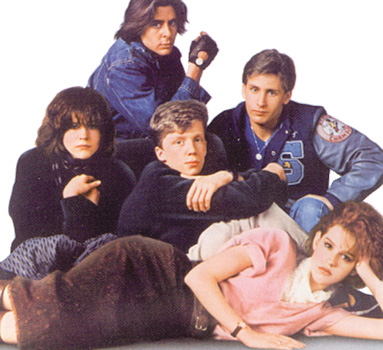
 P.S.- It's also strange, all these years later, to see that Seth Rogen actually had a small part in this film (that's him in the back row). The part is so small I don't even think his character is ever given a name, but it was his first film role after starring in Judd Apatow's cult TV show Freaks and Geeks
Update- I found that original Donnie Darko review on IMDB and, despite how embarrassingly amateur and nonsensical it is (I clearly have no idea what I am talking about), have decided to post it in all of it's original, unedited glory:
What would happen if M. Night Shyamalan had let sam Ramai direct The Sixth Sense? You would probably get something like Donnie Darko. This film is so psycholigically complex I don't even know where to begin. The film is simply brilliant in that it has so many different issues weaven together to create on huge ball of irony, that one finds blinking may take your eyes off the screen for much to long. From the very beginning you get the feeling that this film has more to it than meets the eye. At first glance one may write it off as a modern day attempt at Poltergiest. After veiwing the trailer you may even want to consider it a brainless slasher movie but nothing could be further from the truth.
What would happen if M. Night Shyamalan had let sam Ramai direct The Sixth Sense? You would probably get something like Donnie Darko. This film is so psycholigically complex I don't even know where to begin. The film is simply brilliant in that it has so many different issues weaven together to create on huge ball of irony, that one finds blinking may take your eyes off the screen for much to long. From the very beginning you get the feeling that this film has more to it than meets the eye. At first glance one may write it off as a modern day attempt at Poltergiest. After veiwing the trailer you may even want to consider it a brainless slasher movie but nothing could be further from the truth.
What we have here is the tale of a teenager who's name is Donnie Darko. But Donnie isn't your average teen, see he finds himself drawn at night to a myseterious force named Frank. Frank is a bunny who teels Donnie that in 28 days , on Halloween, the world will end. We also have Donnie's girlfreidn who had to move away because her step-father stabbed her mom in the chest four times and seems to be living a life of torment and personal angst all fueled by fear. Fear is a hard topic in the movie, infact I would say that that one world "fear" us the basis for everything to come.
We also have Jim Cunningham, a motivational speaker that teaches that fear and love are the two strongest emotions that a human has and learn to live your life in the love spectrum of life and avoid the fear. Then we have Grandma Death, an old lady who may just be the most important piece of this huge puzzel. She stands in the middle of the road all day, occasionlly walking to her mailbox to always be greeted by nothing inside. One day after Donnie's father almost runs her over she wispers in his ear "Everyone dies alone." Donnie later finds out that in the past she was a teacher and wrote a book on time travel (but to understand that without giving away the plot you must see the film).
This comment comes up at Donnie's therepy and along with stories of Frank the bunny his shrink believes that Donnie is afraid to connect with reality due to a great fear of what may come from it. It pains me to say this but the climax of the matches, if not surpasses that of The Sixth Sense as everything finally starts to make sense. This will not only leave you wide-eyed, it will probably take your breathe away as well. The acting is all top notch including as cast of Drew Barrymore, Patrick Swazey and the gripping Jake Gyllenhaal as Donnie in his most mature role yet.
The love/fear topic is present throughout the entire film and you can look for hidden signs of this scattered all over the film. One example of this is the billing of Evil Dead and The Last Temptation of Christ as a double feature at the theater. The film is horrifying and edgy without becoming cliched or unoriginal, making it not on;t the best, if you will, horror movie I've seen since The Sixth Sense, it is hands down the best movie of the year so far.