 So the reputable Jeremy Richey over at Moon in the Gutter is hosting a blog-a-thon dedicated entirely to, depending on who you talk to, everyone favourite or least favourite contemporary auteur Paul Thomas Anderson. Being one of my favourite filmmakers I will, of course, be participating. So swing 'round Moon in the Gutter from September 13th to 19th and check out everyone's diverse take on this fascinating filmmaker.
Showing posts with label Paul Thomas Anderson. Show all posts
Showing posts with label Paul Thomas Anderson. Show all posts
Monday, August 30, 2010
A Blog-a-Thon to Remember
So the reputable Jeremy Richey over at Moon in the Gutter is hosting a blog-a-thon dedicated entirely to, depending on who you talk to, everyone favourite or least favourite contemporary auteur Paul Thomas Anderson. Being one of my favourite filmmakers I will, of course, be participating. So swing 'round Moon in the Gutter from September 13th to 19th and check out everyone's diverse take on this fascinating filmmaker.

Tuesday, March 16, 2010
Boogie Nights

“What can you expect when you're on top? You know? It's like Napoleon. When he was the king, you know, people were just constantly trying to conquer him, you know, in the Roman Empire. So, it's history repeating itself all over again.”- Dirk Diggler, Boogie Nights.
If Paul Thomas Anderson’s 1996 debut film Hard Eight planted the seeds for a great talent to grow from, his 1997 sophomore feature Boogie Nights was the sum of that greatness coming into full fruition. Hard Eight worked to establish Anderson with a strong visual aesthetic (sweeping tracking shots, abrupt push-ins, much akin to those of Scorsese and Altman), a knack for sharp dialogue, and a laying of the foundations for the overarching themes that would pulsate under the skin of the rest of the director’s works. However, unlike the great American auteurs of the 70s whom Anderson idolized, the visual symbols in Hard Eight lacked cohesion, and were mostly played as sight gags, as when a book of matches spontaneously combusts in main character John’s pocket as he waits in line at the movies.
 In order to understand how all of the thematic elements of Boogie Nights could revolve around thirteen inches of prosthetic rubber, it seems a fruitful task to first analyze how the main themes of the film are themselves presented. The first is the porn industry itself, which stands in as an allegorical representation of the shifting cultural currents that lead America into Ronald Regan’s 1980s. James Mottram in his book The Sundance Kids describes Dirk Diggler’s rise to fame as, “Living proof that, in America, you can reinvent yourself and live out the Dream, Dirk soon pampers himself with the trappings of success” (188). The irony of Dirk’s rise to fame though is twofold. Dirk is at the height of his popularity at the end of the 70s, a time of freedom and revolution, when, as Roger Ebert states, “A director can dream of making [a porno] so good that the audience members would want to stay in the theater even after they had achieved what they came for” (1997).
 Of course Diggler is not the only one to be brought down by the 80s. Dirk’s friend Todd Parker is gunned down in one of the films most brilliant scenes after a drug deal goes awry, suggesting that, where drug use in the 70s was seen as a way to experiment with freeing ones mind, it has transformed into a breeding ground for paranoia and violence in the 80s; Jack Horner has capitalism forced on him when he begins shooting cheap films on the video format; the Colonel is put in jail of charges of sex with a minor; porn star Amber Waves is denied the right to see her children while her lawyer, in one of those detailed tongue-in-cheek winks from Anderson, is placed in the frame between portraits hanging on the wall behind of Richard Nixon on the left and Ronald Regan on the right (the side of the table her conservative, anti-porn husband inhabits); and Buck Swope who, in Anderson’s most striking image of the corruption of 80s culture, has a heavy burden put upon him.
  After surviving an armed robbery in a convenience store that ends in bloodshed, Swope, who earlier that day was denied a loan from the bank in order to help him open his own business, stands surrounded by death, covered in blood, the camera slowly zooming in on the blood soaked bag of money which the burglar tried to make off with. The implications that arise from Anderson’s focus on the bag are both bleak and powerful. After being denied the means that would enable Buck to chase the American Dream by opening his own business, by an institution organized to help people do just that, Buck is forced to such extremes that he is willing to steal a bag of money which is covered with the blood of a stranger. The message is clear: chasing the American Dream in the 80s comes at the expense of your fellow man.
If Paul Thomas Anderson’s 1996 debut film Hard Eight planted the seeds for a great talent to grow from, his 1997 sophomore feature Boogie Nights was the sum of that greatness coming into full fruition. Hard Eight worked to establish Anderson with a strong visual aesthetic (sweeping tracking shots, abrupt push-ins, much akin to those of Scorsese and Altman), a knack for sharp dialogue, and a laying of the foundations for the overarching themes that would pulsate under the skin of the rest of the director’s works. However, unlike the great American auteurs of the 70s whom Anderson idolized, the visual symbols in Hard Eight lacked cohesion, and were mostly played as sight gags, as when a book of matches spontaneously combusts in main character John’s pocket as he waits in line at the movies.
Boogie Nights would be the film that changed all of that as it was the film where Anderson learned to string his images together in order to create a coherent understanding of the overriding themes within his narratives. Every subsequent Anderson narrative from Boogie Nights on would be structured around one or two central images or visual motifs that would tie the entire film together, and in Boogie Nights it’s a doozey.
The themes are familiar: a young teenager leaves his unsupportive family in order to venture off and acquire a new surrogate one that will support his true talents, and how the shifting cultural currents were changing the way the world of porn (a metaphorical symbol in itself, which stands in for society as a whole) functioned. All of this is framed around the simple image of main character Dirk Diggler’s penis.
In order to understand how all of the thematic elements of Boogie Nights could revolve around thirteen inches of prosthetic rubber, it seems a fruitful task to first analyze how the main themes of the film are themselves presented. The first is the porn industry itself, which stands in as an allegorical representation of the shifting cultural currents that lead America into Ronald Regan’s 1980s. James Mottram in his book The Sundance Kids describes Dirk Diggler’s rise to fame as, “Living proof that, in America, you can reinvent yourself and live out the Dream, Dirk soon pampers himself with the trappings of success” (188). The irony of Dirk’s rise to fame though is twofold. Dirk is at the height of his popularity at the end of the 70s, a time of freedom and revolution, when, as Roger Ebert states, “A director can dream of making [a porno] so good that the audience members would want to stay in the theater even after they had achieved what they came for” (1997).However, all of this changes on News Years Eve as Dirk and his newfound family welcome in the 80s at his plush new house, as two specific events occur that suggest the death of the 70s freedom and the entering of the closed-minded yuppiedom of 80s Reganonmics; a transition that Sharon Waxman in her book Rebels on the Backlot describes perfectly as, “A vehicle for telling a story about a reconstructed family, devolving from the 70s party into the hangover of drug addiction and broken lives” (118). The two images Anderson gives us are firstly the character of Floyd Gondolli, the man with the money, who crashes the party to inform director Jack Horner that the future of porn lies in video. Floyd’s presence builds a bridge not only for the transition between years but for the transition of the porn industry from art form to assembly line commodification, produced cheap, in low quality and to serve only one purpose: to provide orgasm.
 Gondolli acts as a trigger for the second image, which most literally visualizes the death of the porn industry and the surrogate family, as assistant director Lil' Bill pulls a gun at the party and shoots his wife before turning it on himself. That Anderson films this ironic act of startling violence straight on, with Bill standing in front of a blank white wall, signals almost imminent doom for Diggler, who now has the bloodstains of the past covering the walls of his home. From this moment on, there is no escape.
Gondolli acts as a trigger for the second image, which most literally visualizes the death of the porn industry and the surrogate family, as assistant director Lil' Bill pulls a gun at the party and shoots his wife before turning it on himself. That Anderson films this ironic act of startling violence straight on, with Bill standing in front of a blank white wall, signals almost imminent doom for Diggler, who now has the bloodstains of the past covering the walls of his home. From this moment on, there is no escape. As 80s capitalism wages war on Diggler, he begins to drown in the haze of drug addiction, is beaten after reducing himself to offering cheap sexual favors for men in the confines of their vehicles, the family is broken up by greed and flaring egos, and pornography is reduced to no more than, as Mottram suggests, a perverse way for guys to get a quick fix (194). No wonder 1979 literally ended with a bang of tragedy instead of celebration.
Of course Diggler is not the only one to be brought down by the 80s. Dirk’s friend Todd Parker is gunned down in one of the films most brilliant scenes after a drug deal goes awry, suggesting that, where drug use in the 70s was seen as a way to experiment with freeing ones mind, it has transformed into a breeding ground for paranoia and violence in the 80s; Jack Horner has capitalism forced on him when he begins shooting cheap films on the video format; the Colonel is put in jail of charges of sex with a minor; porn star Amber Waves is denied the right to see her children while her lawyer, in one of those detailed tongue-in-cheek winks from Anderson, is placed in the frame between portraits hanging on the wall behind of Richard Nixon on the left and Ronald Regan on the right (the side of the table her conservative, anti-porn husband inhabits); and Buck Swope who, in Anderson’s most striking image of the corruption of 80s culture, has a heavy burden put upon him. After surviving an armed robbery in a convenience store that ends in bloodshed, Swope, who earlier that day was denied a loan from the bank in order to help him open his own business, stands surrounded by death, covered in blood, the camera slowly zooming in on the blood soaked bag of money which the burglar tried to make off with. The implications that arise from Anderson’s focus on the bag are both bleak and powerful. After being denied the means that would enable Buck to chase the American Dream by opening his own business, by an institution organized to help people do just that, Buck is forced to such extremes that he is willing to steal a bag of money which is covered with the blood of a stranger. The message is clear: chasing the American Dream in the 80s comes at the expense of your fellow man.This brings us back full circle to Dirk’s penis, which acts as the ultimate symbol for the transition between the glamour and artistic freedom of the 70s and the cold conservative capitalism of the 80s. This is in part due to the way Anderson uses the penis within the framework of the narrative. In the 70s it remains totally elusive to the audience. We hear talk of it, and we learn of its greatness through the employment of reaction shots of Roller Girl, the Colonel, etc. However, it isn’t until the 80s (the last shot of the film to be exact) after Diggler has battled addiction, lost his second family, and been beaten down and throw away by society that we actually get to see the coveted member. By waiting until the last scene to show us the penis, Anderson has provided a sly, if tragic, dig at the pathetic institution the porn industry and Diggler have become in the 80s. Just as video acted in the New Years Eve sequence, Dirk’s penis, when we finally see it, provides the perfect image of capitalist commodifiction. By the time the penis rears its head, its greatness has been muted as it no longer possesses a unique individual quality. Size is no longer more important than mass production, as quality is no longer more important than quantity. Diggler may have rejoined his family at the end of the film, but he is no longer a star, rather a simple cog in the capitalist machine, installed to produce an assembly line product.
 If Anderson had shown us the penis during the 70s, we would have been blinded by its magnificent power. However, now at the end of the film, its luster has faded and we can look at it without harm because it is no longer one of a kind. Diggler, like Napoleon, has been conquered, as all great men of excess eventually are, and the unveiling of his anatomy reveals this. Even more tragic is Dirk’s failure to realize his fall from grace as he declares to the mirror in the same scene “I am a big, bright, shining star.” Thus, the penis and all the other symbols that revolve around it (the surrogate family, the bloody money, the video tapes, Lil' Bill’s suicide) show the tragedy that befell many in the 80s. With many people out of jobs and the deskilling of labour on the rise, many people who, along with Dirk Diggler, were reduced to mere interchangeable parts in a vast capitalist machine.
 If Anderson had shown us the penis during the 70s, we would have been blinded by its magnificent power. However, now at the end of the film, its luster has faded and we can look at it without harm because it is no longer one of a kind. Diggler, like Napoleon, has been conquered, as all great men of excess eventually are, and the unveiling of his anatomy reveals this. Even more tragic is Dirk’s failure to realize his fall from grace as he declares to the mirror in the same scene “I am a big, bright, shining star.” Thus, the penis and all the other symbols that revolve around it (the surrogate family, the bloody money, the video tapes, Lil' Bill’s suicide) show the tragedy that befell many in the 80s. With many people out of jobs and the deskilling of labour on the rise, many people who, along with Dirk Diggler, were reduced to mere interchangeable parts in a vast capitalist machine.
 Read about Magnolia and Punch-Drunk Love
Magnolia
Yesterday, after reading a post on Punch-Drunk Love, I had my love of Paul Thomas Anderson re-awoken and therefore got the desire to take a section out of an essay I wrote on him in university and post it. Reading over that section of the essay then made me want to take out the other two sections on Magnolia and Boogie Nights and post them to, because, well, what's the point in neglecting 2/3s of a perfectly good essay? So here is the section on Magnolia, with the section on Boogie Nights soon to follow.
 And it is in the humble opinion of this narrator that strange things happen all the time. And so it goes, and so it goes. And the book says, "We may be through with the past, but the past ain't through with us."- Narrator, Magnolia
It is these musing by the narrator of Magnolia, Anderson’s third, epic masterpiece of a film, that outline the very essence of both the dominant themes within the film’s narrative: that the sins of the past will be passed on to the recipients of the present, and that, as James Mottram explains, “The universe is made up of chance events. Human life is accidental- or…we live in a world where human actions have meaning and consequences, for better or worse” (261).
In order to explore the theme of a father passing on his misgivings to his son, Anderson, much like Altman in Short Cuts (1993) or Nashville (1975), creates a vast labyrinth of characters whose connections, in one way or another, all revolve around the television game show What do Kids Know?
The show, although a celebration of children and their knowledge, is also a front for the breakdown of the relationship between parent and child. The show’s producer is dying of cancer (a symbol used to represent the atonement of one’s sins as it isn’t until after contracting the disease that both Earl Partridge and Jimmy Gator attempt to reconcile with their estranged children) and hated by his alienated son who feels he was abandoned and forced to tend to his dying mother. The show’s host is also dying and is hated by his drug addicted daughter who accuses him of molesting her when she was younger; the former star of the show has refused to grow up and instead boozes uncontrollably, exploiting his minimal celebrity in order to make a living; and his mirror image, the current star of the show, whose father seems to care more about personal glory than the well being of his son.
 This child character, Stanley, provides one of the film’s many key metaphors for the fractured relationship between parent and child as he wets his pants after being refused access to the bathroom during a commercial break, after which he becomes introverted and refuses to continue playing the game. Anderson cross cuts with images of Stanley’s father throwing a tantrum in the dressing room when Stanley misses questions he should know, as if to suggest that his son’s refusal to play the game acts as his own personal embarrassment. When the father approaches Stanley during a commercial break, he is unsympathetic in regards to the child’s urine soaked pants, warning him to get back in the game, as if his own personal pride depends on it. Stanley’s refusal to continue playing is Anderson’s way of showing the deteriorating of Stanley’s feeling of self worth; why after all, should he exist in a world where his simple needs, like going to the washroom, are placed below the pride of winning a petty game show?
 This is an important image because it also works in comparison to Former Wiz Kid Donnie Smith’s grand emotional scene, in which he announces that it is “alright to confuse children with angels,” and ends with Smith vomiting into a toilet while uttering a barely audible biblical reference (Exodus 20:5) about how the sins of the father will be passed on to his children. The scene acts as a call for intervention; a summation of Anderson’s theme regarding how the actions of one person have consequences on another. The scene is a symbol of hope that Stanley will break the cycle and not go down the same path: to end up with his head in a toilet at a bar like the pathetic, miserable Donnie Smith, who was once in the exact same position as him. Anderson is once again showing us that the consequences of one person’s actions have a severe affect on another because we are all interconnected in some way. If Stanley’s dad continues to treat him so lowly, his future will not be much better than Donnie’s.
 The central symbol in Magnolia however, is also its most infamous: the frogs. Anderson, much like Altman does with his earthquake in Short Cuts, has it rain frogs over all of the characters in order to provide them all with a religious cleansing. The incident happens without build up, (although Anderson sneakily litters hidden references to the plague of frogs from Exodus 8:2 throughout the entire film), and ends without explanation. Sharon Waxman, with the help of Anderson himself attempts to explain the significance of the frog rain: “When [Anderson] heard about the frogs, he thought they could represent a sign in the story, or a warning. ‘There are certain moments in your life when things are so fucked-up and so confused that someone can say to you, ‘it’s raining frogs’ and that makes sense,’ Anderson said” (195). Where the frogs act as a warning sign in the Bible, here they also function as a means to cleanse the characters of their sins and provide them with a new beginning, especially for naive cop Jim Kurring (the peacekeeper of the cast), whose lost gun also falls from the sky after the frogs stop, who thus gives Donnie Smith a second chance at life, after catching him breaking in to his former place of employment in order to steal money; showing once again how our own actions always effect those around us.
Another function of the frog sequence is to unite the entire cast through a common emotional thread. The second sequence to do this, it acts in combination with the first in which, in one of the most bold and beautiful uses of music ever committed to film, has all of the characters frozen in time, singing in unison the lyrics to Amiee Man’s “Wise Up” which also plays on the soundtrack. The chorus proclaims that “It’s not going to stop, until you wise up,” providing an insightful moment of self-reflection in which the characters realize that their lives have all begun to spin out of control and it is their job to reflect on their past sins in order to “wise up” and live better in the future. This provides Anderson with a bridge that leads right into the frog sequence, where the characters are all metaphorically anointed by the frogs, an act of God that allows them to step outside of themselves and be reminded that sometimes life becomes so tumultuous that we forget that there are greater forces working in the universe, which are beyond ourselves. It’s a reminder we all could use every once in a while.
And it is in the humble opinion of this narrator that strange things happen all the time. And so it goes, and so it goes. And the book says, "We may be through with the past, but the past ain't through with us."- Narrator, MagnoliaIt is these musing by the narrator of Magnolia, Anderson’s third, epic masterpiece of a film, that outline the very essence of both the dominant themes within the film’s narrative: that the sins of the past will be passed on to the recipients of the present, and that, as James Mottram explains, “The universe is made up of chance events. Human life is accidental- or…we live in a world where human actions have meaning and consequences, for better or worse” (261).
In order to explore the theme of a father passing on his misgivings to his son, Anderson, much like Altman in Short Cuts (1993) or Nashville (1975), creates a vast labyrinth of characters whose connections, in one way or another, all revolve around the television game show What do Kids Know?
The show, although a celebration of children and their knowledge, is also a front for the breakdown of the relationship between parent and child. The show’s producer is dying of cancer (a symbol used to represent the atonement of one’s sins as it isn’t until after contracting the disease that both Earl Partridge and Jimmy Gator attempt to reconcile with their estranged children) and hated by his alienated son who feels he was abandoned and forced to tend to his dying mother. The show’s host is also dying and is hated by his drug addicted daughter who accuses him of molesting her when she was younger; the former star of the show has refused to grow up and instead boozes uncontrollably, exploiting his minimal celebrity in order to make a living; and his mirror image, the current star of the show, whose father seems to care more about personal glory than the well being of his son.
This child character, Stanley, provides one of the film’s many key metaphors for the fractured relationship between parent and child as he wets his pants after being refused access to the bathroom during a commercial break, after which he becomes introverted and refuses to continue playing the game. Anderson cross cuts with images of Stanley’s father throwing a tantrum in the dressing room when Stanley misses questions he should know, as if to suggest that his son’s refusal to play the game acts as his own personal embarrassment. When the father approaches Stanley during a commercial break, he is unsympathetic in regards to the child’s urine soaked pants, warning him to get back in the game, as if his own personal pride depends on it. Stanley’s refusal to continue playing is Anderson’s way of showing the deteriorating of Stanley’s feeling of self worth; why after all, should he exist in a world where his simple needs, like going to the washroom, are placed below the pride of winning a petty game show? This is an important image because it also works in comparison to Former Wiz Kid Donnie Smith’s grand emotional scene, in which he announces that it is “alright to confuse children with angels,” and ends with Smith vomiting into a toilet while uttering a barely audible biblical reference (Exodus 20:5) about how the sins of the father will be passed on to his children. The scene acts as a call for intervention; a summation of Anderson’s theme regarding how the actions of one person have consequences on another. The scene is a symbol of hope that Stanley will break the cycle and not go down the same path: to end up with his head in a toilet at a bar like the pathetic, miserable Donnie Smith, who was once in the exact same position as him. Anderson is once again showing us that the consequences of one person’s actions have a severe affect on another because we are all interconnected in some way. If Stanley’s dad continues to treat him so lowly, his future will not be much better than Donnie’s. The central symbol in Magnolia however, is also its most infamous: the frogs. Anderson, much like Altman does with his earthquake in Short Cuts, has it rain frogs over all of the characters in order to provide them all with a religious cleansing. The incident happens without build up, (although Anderson sneakily litters hidden references to the plague of frogs from Exodus 8:2 throughout the entire film), and ends without explanation. Sharon Waxman, with the help of Anderson himself attempts to explain the significance of the frog rain: “When [Anderson] heard about the frogs, he thought they could represent a sign in the story, or a warning. ‘There are certain moments in your life when things are so fucked-up and so confused that someone can say to you, ‘it’s raining frogs’ and that makes sense,’ Anderson said” (195). Where the frogs act as a warning sign in the Bible, here they also function as a means to cleanse the characters of their sins and provide them with a new beginning, especially for naive cop Jim Kurring (the peacekeeper of the cast), whose lost gun also falls from the sky after the frogs stop, who thus gives Donnie Smith a second chance at life, after catching him breaking in to his former place of employment in order to steal money; showing once again how our own actions always effect those around us.Another function of the frog sequence is to unite the entire cast through a common emotional thread. The second sequence to do this, it acts in combination with the first in which, in one of the most bold and beautiful uses of music ever committed to film, has all of the characters frozen in time, singing in unison the lyrics to Amiee Man’s “Wise Up” which also plays on the soundtrack. The chorus proclaims that “It’s not going to stop, until you wise up,” providing an insightful moment of self-reflection in which the characters realize that their lives have all begun to spin out of control and it is their job to reflect on their past sins in order to “wise up” and live better in the future. This provides Anderson with a bridge that leads right into the frog sequence, where the characters are all metaphorically anointed by the frogs, an act of God that allows them to step outside of themselves and be reminded that sometimes life becomes so tumultuous that we forget that there are greater forces working in the universe, which are beyond ourselves. It’s a reminder we all could use every once in a while.
Monday, March 15, 2010
Punch-Drunk Love

Today Kevin J. Olson over at Hugo Stiglitz Makes Movies (check it out!) wrote a post about Punch-Drunk Love which A) reminded me how much I love that movie and B) made me remember that I wrote an essay in University about how Paul Thomas Anderson is a director who tells his stories through images and one section of that essay was dedicated to Punch-Drunk Love. Unfortunately the bulk of the essay focuses on Boogie Nights, but I think what I wrote provides a nice contast to the ideas that Olson brings forth. Check it out and then go check his out.
I have a love in my life. That makes me stronger than you could ever imagine- Barry Egan, Punch-Drunk Love
After a, expansive epic like Magnolia, a film like 2002s Punch-Drunk Love, at a mere ninety minutes, feels like a minor work from Paul Thomas Anderson. However, upon closer inspection, one finds that PDL is Anderson’s most focused and coherent film, while also managing to be his most artistically daring. Not only is the running time of the film the opposite of Anderson’s two previous epics, but it also plays like their backwards reflection, as it opens with the film’s key image and instead of being about the desire to repair family relations, its main character seeks to break away from them as they are an agent of torment for him. PDL is also an experiment of sorts for Anderson because, instead of using his images to tell the story, he uses them instead to provide a physical projection of Barry’s inner psyche onto the world around him. When Barry Egan is trapped in his office, trying to engage in conversation with possible love interest Lena, his sisters constantly demanding his attention on the phone, his crew experience chaos as a fork lift crashes into a self, sending boxes crashing to the ground, we get to realizing that Anderson is giving us a physical reenactment of what it must be like to be living inside Barry’s head at any given moment. It is a jarring and daring method of metaphysical filmmaking.
I have a love in my life. That makes me stronger than you could ever imagine- Barry Egan, Punch-Drunk Love
After a, expansive epic like Magnolia, a film like 2002s Punch-Drunk Love, at a mere ninety minutes, feels like a minor work from Paul Thomas Anderson. However, upon closer inspection, one finds that PDL is Anderson’s most focused and coherent film, while also managing to be his most artistically daring. Not only is the running time of the film the opposite of Anderson’s two previous epics, but it also plays like their backwards reflection, as it opens with the film’s key image and instead of being about the desire to repair family relations, its main character seeks to break away from them as they are an agent of torment for him. PDL is also an experiment of sorts for Anderson because, instead of using his images to tell the story, he uses them instead to provide a physical projection of Barry’s inner psyche onto the world around him. When Barry Egan is trapped in his office, trying to engage in conversation with possible love interest Lena, his sisters constantly demanding his attention on the phone, his crew experience chaos as a fork lift crashes into a self, sending boxes crashing to the ground, we get to realizing that Anderson is giving us a physical reenactment of what it must be like to be living inside Barry’s head at any given moment. It is a jarring and daring method of metaphysical filmmaking.
The key image in PDL, much like the frogs in Magnolia, appears without warning or explanation. It is a small piano, latter identified be Lena as a harmonium (an ironic twist, as the harmonium is the key object that Barry clings to in moments of unbearable chaos. It, much like her, is the sole object that can sooth Barry’s soul), which is mysteriously ejected from a cab and placed on the sidewalk in front of Barry’s place of business after a van flips over due to a violent explosion and then instantly disappears. Here Anderson is setting up a metaphorical divide in Barry’s psyche. By providing us with a violent image, followed by an innocent one, Anderson shows us the dual nature of Barry who is both a naive child with no true sense of how human communication works in the everyday world, but also a ball of burning rage that oozes beneath the surface just waiting to explode. This is a contradiction we see constantly recurring throughout the film, most notably in a delicate scene where Barry tells Lena that she is so beautiful he just wants to get a hammer and smash her face in.
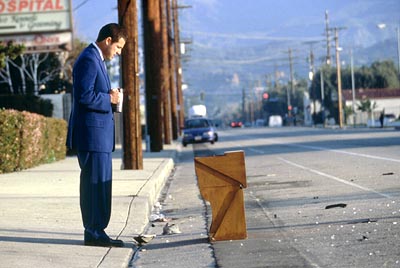 clings to in moments of unbearable chaos. It, much like her, is the sole object that can sooth Barry’s soul), which is mysteriously ejected from a cab and placed on the sidewalk in front of Barry’s place of business after a van flips over due to a violent explosion and then instantly disappears. Here Anderson is setting up a metaphorical divide in Barry’s psyche. By providing us with a violent image, followed by an innocent one, Anderson shows us the dual nature of Barry who is both a naive child with no true sense of how human communication works in the everyday world, but also a ball of burning rage that oozes beneath the surface just waiting to explode. This is a contradiction we see constantly recurring throughout the film, most notably in a delicate scene where Barry tells Lena that she is so beautiful he just wants to get a hammer and smash her face in.
 That scene, although seemingly violent by design, actually provides a startling moment of revelation when placed in comparison with the story his seven sisters tell of the time he smashed the sliding glass door at home with a hammer. By expressing his love for Lena via wishing to smash her face with a hammer, Anderson is showing us a shift in Barry, who no longer desires to put his energy into bursts of violent rage but rather, to putting all of his energy into loving Lena with all his heart.
That scene segues perfectly into the film’s second key image (the p hone) and the final scene in which Barry encounters the mattress man Dean Trumbell who harasses Barry after having called a phone sex line, and whose goons also put Lena in the hospital after crashing into Barry’s car. The phone is a cause for much anxiety in Barry’s life, like how his sisters constantly harass him at work with their insistent calls. Also the phone is the sole object that stands between Barry and his ability to fully commit himself to Lena because it acts as a constant reminder of Barry’s relationship to Trumbell. It is only with slight irony that, when going to see Trumbell, Barry arrives with the receiver of his home phone in hand, the cord dragging behind. It is here that Barry mutters the classic line about having a love in his life, and, in the films most uplifting dedication of love, finally hands the phone off to a spare employee after threatening to “beat the hell” from Trumbell.
 hone) and the final scene in which Barry encounters the mattress man Dean Trumbell who harasses Barry after having called a phone sex line, and whose goons also put Lena in the hospital after crashing into Barry’s car. The phone is a cause for much anxiety in Barry’s life, like how his sisters constantly harass him at work with their insistent calls. Also the phone is the sole object that stands between Barry and his ability to fully commit himself to Lena because it acts as a constant reminder of Barry’s relationship to Trumbell. It is only with slight irony that, when going to see Trumbell, Barry arrives with the receiver of his home phone in hand, the cord dragging behind. It is here that Barry mutters the classic line about having a love in his life, and, in the films most uplifting dedication of love, finally hands the phone off to a spare employee after threatening to “beat the hell” from Trumbell.
Another use of symbols worth exploring is the way Anderson uses colour in PDL, especially red and white, as discussed by Cubie King in his essay Punch-Drunk Love: The Budding of an Auteur. Cubie assess that, “Red serves as the colour that leads to Barry’s happiness” (2005). Cubie could be on to something as he recalls significant moments of red being used: the woman dressed in red in the background at the supermarket as Barry looks for items he can earn frequent flyer miles off of, the red cab that drops the harmonium onto the sidewalk, the stewardesses dressed in red who wait at the end of the terminal for Barry to board the plane to Hawaii, and the red arrow which shows Barry the way to escape from the four blonde brothers (2005); all signs leading to Barry’s happiness.
White on the other hand, according to Cubie, acts as the opposite. It is his “op pressor” (2005). The white walls of Barry’s headquarters entrap him, the white phone receiver which is the cause of much anxiety for Barry, and the white hallways which Barry must frantically run through in order to get back to Lena for their first kiss, etc. Thus, further exemplifying Anderson’s desire to make PDL play like a physical representation of his main character’s fragmented psychological state, and, as a result, crafting a film that has come closer to any since Scorseses’ After Hours (1986), to providing an in depth representation of character psychology entirely through images.
pressor” (2005). The white walls of Barry’s headquarters entrap him, the white phone receiver which is the cause of much anxiety for Barry, and the white hallways which Barry must frantically run through in order to get back to Lena for their first kiss, etc. Thus, further exemplifying Anderson’s desire to make PDL play like a physical representation of his main character’s fragmented psychological state, and, as a result, crafting a film that has come closer to any since Scorseses’ After Hours (1986), to providing an in depth representation of character psychology entirely through images.
Subscribe to:
Posts (Atom)