There’s no excuse for The Expendables but then again, why should there have to be? This is a film that bathes in the excesses of its forefathers; a throwback to the 80s heyday of macho action heroes destroying everything in their sight in order to protect the girl/save the innocents/bring down the bad guy. You know the drill: no building left standing, no vehicle left uncharred, no faceless solider left standing, no piece of grass left unsinged. I can’t, in any sort of good conscience, recommend it; it’s too shallow, too broad, too cheap looking, not witty enough and, as a throwback, lacks the kind of personality that made its referents so special, but anyone who sees it will, I suspect, be getting their money’s worth.
Sylvester Stallone (who also directs and co-writes) stars as Barney Ross, the main badass in a team of ragtag elite fighters. They’re like the A-Teamexcept, since they are all played by discernible action movie heroes of different varieties (Jason Statham, Jet Li, Mickey Rourke, Dolph Lundgren) Stallone doesn’t rely on providing generic types so much as simply coasts on the presence of his stacked line-up. That’s fair, it’s like trading in one superficiality for another but Stallone uses his team as a reason to coast: presence only goes so far if you don’t get to caring about the hero your tagging along with.
Thus the film coasts lightly on the surface, afraid to ever delve deeper into any emotional interest lest it get in the way of blowing stuff up. It’s never really explained how The Expendables know each other, who pays their bills, and just whether or not what they are doing is technically legal. In fact, the only time we ever do get a glance at anything genuinely human is when Mickey Rourke, as the old dog who mans the HQ, conveys a painful story from his past and runs away with the movie.
The mission, given to Stallone by a no-nonsense Bruce Willis, after being passed on by Arnold Schwarzenegger in one of the films true guilty pleasure scenes, is to travel to a remote Latin American country and rid it of, oh I don’t know, anyone who doesn’t look like a friend to the U.S.? Ruling over the country is an evil dictator who is secretly at the mercy of an evil American ex-agent played by Eric Roberts, who, as far as villains go, is basically a stock character who stands around with a menacing scowl because, you know, these things need villains. It’s never quite explained what Robert’s purpose is, why he holds command over the dictator or what he wants to achieve but hey, his number one heavy is played by “Stone Cold” Steve Austin. You see how it works?
So the team visit the country, case it, meet a young beauty who is both a revolutionary and the general’s daughter, and narrowly escape after they are detected. But just to show those slimy South Americans they blow the hell out of their harbour via airplane machine guns. What they actually discover when there is a mystery to me, but whatever it is, it prompts them to return with some serious firepower and lay waste to everything in their sights, all in order to, I guess, save the girl while, along the way, just for flavour, one of them crosses over onto the other team’s side.
What more description of The Expendables does one need? A lot of things go boom, while little plot gets in the way. The film is funny but not nearly funny enough and, as was the case with Stallone’s Rambo, the violence, at times, is far too serious to be taken as entertainment. At other times, when CGI is employed the film looks cheap: the bloodshed reminiscent circa 1998 arcade violence.
And yet there is a certain sense of freewheeling fun on display here. One must nod in admiration at a film that is willing to pull out all the stops and not apologize for it for better or worse and the film, for the most part, features action that feels more or less authentic. As a throwback the film undershoots its target but as an excessive display of recognizable faces laying waste to everything in their path well, what more could you want?
Writers and critics tend to make, sometimes shameless, use of hyperbole. That's what calling the summer of 2010 the worst summer at the movies ever is. Strangely, I've read, if not exactly that statement, something close to it more often than not. Even many reviews of Inceptionseem to need to first provide some context by letting readers know that this movie has come out in an awful summer. But what are people basing this on? We need some context for the context. What are you defining as a "bad summer?" Is there another bad summer which we are using for a comparative starting point, or is there a clear definition of what a good summer at the movies needs to look like?
If anything, this summer is no worse than last summer. Actually it may be a little better, and it's not even over yet. Sure, not many of the titles will go down in history, but how many of them actually ever do? The summer is about kicking back, having fun, letting the critical safety net slip a little and just enjoying yourself. Sure, Hollywood is phoning it in this summer but who cares that few of these movies will stand the test of time? The point is, as Pauline Kael once wrote in one of the most important pieces of American film criticism every put on paper, to not consume great art, but to enjoy ourselves.
And enjoy myself I have been. Sure the box office is down on a lot of films and maybe next year Hollywood will have learned their lesson and give us less films edited in blenders on full speed and more big budget entertainments made by competent artists who know how to walk the line between commercial and quality. But on that note, we work with what we have not what we want, and what we have, when you look at the titles, isn't half bad.
Sure there were some big stinkers. Sex and the City 2 is about as bad a movie as I can think of, The A-Team was just about the worst made action movie of the year and Twilight:Eclipsewas bad, but who thought it wouldn't be? And even with the latter titles, there were some out there who sincerely enjoyed A-Team and argued that Eclipse was the best of the three movies thus far, whatever that means. Also Marmaduke and Killers crashed and burned and although Shrek 4 raked in the dough, Shrek hasn't been good since the first film. And oh ya, The Last Airbender. 'Nuff said.
And then, there were a lot of good ones. The Losers opened the summer to embarrassing numbers but was still a highly enjoyable action movie with a nice performance from Jason Patrick. Both Get Him to the Greek and The Karate Kid were sequels/remakes with no expectations that delivered on the goods. Iron Man 2 didn't quite work for me but it did for a lot of others and even though I think Toy Story 3 is more minor than many have given it credit for, Pixar still managed to deliver again.
Although some of the more cynical and jaded skipped Knight and Day because it's star once jumped on a couch, it was a genuinely well made, funny action flick and now Salt (review this week) is supposed to be even better, getting a four star review from Roger Ebert. Even kid flicks Despicable Me and Ramona and Beezus with Selena Gomez are getting surprisingly good reviews. Not to mention the smaller charmers that snuck through the cracks like the wonderful basketball romance Just Wright, Cyrus with Jonah Hill and The Kids Are Alright with Julianne Moore. And, of course, Inception, which was praised by critics, loved by audiences and certainly the kind of large scale entertainment that every summer needs.
And look, we still have a whole month to go. August, which used to be the month where studios dumped their leftovers has some very promising titles. Will Farrell will maybe redeem his last two or three bad movies against Mark Whalberg in The Other Guys, guilty pleasure series Step-Up will be hitting 3D, Middle Men about the start of Internet porn looks like a teen sex comedy meets Goodfellas, Sylvester Stallone's The Expendables will hopefully bring back the 80s action movie hero aesthetic and give action movies exactly what they've been missing all these years, and Scott Pilgrim doesn't quite have me sold because Edgar Wright still hasn't proven himself to be a great director but many are foaming at the mouth waiting for this.
There's also Eat Pray Love, a human drama with Julia Roberts, a new Nanna McPhee movie, a new Drew Barrymore romantic comedy with the always charming Justin Long, Takers, an interesting looking heist movie and could The Last Exorcism be the new Paranormal Activity? I'm looking forward to finding out.
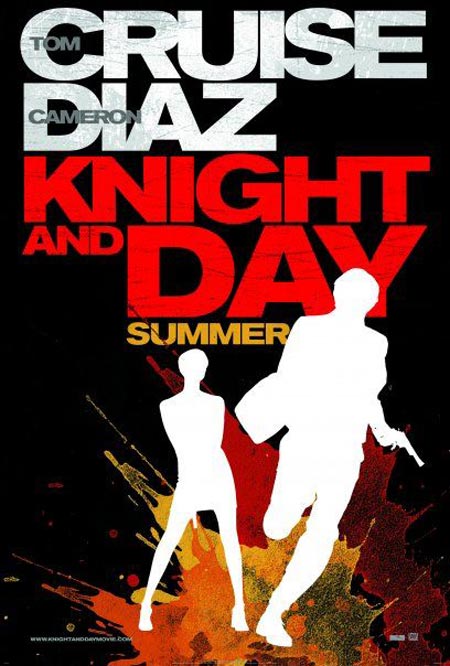
Knight and Day is everything that The A-Team failed to be. It’s an action comedy that is, oddly enough, both funny and exciting; it has characters and not broad types; it’s about movie stars having fun with each other; it has a ridiculous plot and knows how to use that to its personal advantage; it’s the sign of a promising director being able to play the big money game while still delivering a quality product; it has moments where the characters, between chases, shoot-outs and explosions actually get to talk, about things! Who would have thunk? And, most importantly it has action that is made up of stunts, bullets, squibs and explosions made from gas, heat and oxygen all coming together to complete a scientific triangle. Even towards the end, when there is an electrifying motorcycle chase down the streets of Spain, it looks remarkably like two people actually riding a motorcycle. You couldn’t ask for more.
June (Cameron Diaz) meets Roy Miller (Tom Cruise) at the airport after they bump into each other twice. They then have the same flight. But something is strange about Roy. He’s being watched. On the plane, which is nearly empty, she has one too many tequila’s, chats Roy up, goes to the bathroom to compose herself, working out her next move in the mirror and exits to find everyone on the plane dead, including the pilots. At first she doesn’t notice and thinks Roy is joking with her when he tells her he is going to land the plane. Joke’s on her.
On the ground Roy drugs June and before she passes out explains to her that some agents will probably come looking for her, saying that he is dangerous and deranged and they are there to protect her. He warns her not to trust them. She wakes up the next morning in a foggy daze, but whaddya know…
Turns out Roy is in possession of a Maguffin known as the Zephyr, a battery of unlimited power that could, he helpfully explains, run a small city of a large submarine. It was created by a young scientist who Roy was put in charge of guarding along with his partner Fitzgerald (Peter Sarsgaard) who wanted to sell the battery to a Spanish weapon’s dealer and walk off with a big payday. After Roy steals the battery and hides the kid from Fitzgerald, he is framed as going rouge and is being hunted not only by Fitzgerald but by the arms dealer as well.
What results is a collection of high intensity action sequences as Roy tries to clear his name, find the kid, save June from her pursuers and take out Fitzgerald, all while having time to stop for a swim on a tropic island where he appears, shirtless, from the ocean, caring a bundle of prize fish in one hand, not a spear or harpoon in sight. That my friends, is the kind of talent they don’t teach at any agency.
The film is a flight of fancy that ultimately comes down to the chemistry of its stars. Cruise and Diaz are both likable, funny and smooth together. They exchange banter, trade one-liners, crack wise in each other's direction and maintain a flirty mystery throughout the entire film: they think they like each other, but both are too busy dodging bullets, cars, motorcycles, stampeding bulls, etc. for either of them to make a first move.
Diaz once again proves herself a welcome comedic presence. She plays June as a girl both naive but intrigued by the world of violence she has entered. She has a sort of disconnected quality in her performance in which she is shocked and surprised by what is happening around her, leading to many of the film’s funniest moments, but also remains aware of her surroundings, excited by the possibility that adventure could lurk around any corner.
Cruise, one of the few remaining movie stars that become so because of talent and versatility, does the right thing by playing the Miller character totally straight. He’s an action movie every man. When June is taken in by Fitzgerald he speeds by on a motorcycle, ramps it, lands on the hood of the SUV transporting June and takes out all the bad guys, but not before pausing to tell her how much he likes her dress and compliment her driving skills after being forced to take the wheel when Roy puts a bullet in the driver. Cruise as an action hero is cool and sophisticated but also delivers his lines as if he were a regular guy and these feats of ridiculousness are but a part of some daily routine. This off-handed approach gives the film a warmer, more human quality than a typical run-of-the-mill action picture and also allows the characters to develop believably during the down time between big stunts, deepening the story beyond a clothesline of endless action.
Knight and Day is thus possibly the first true big entertainment of the summer. Where action movies seem to have gone the way of crowding human actors out with oodles of computer generated effects and shaky action sequences that are impossible to comprehend, it’s nice to see one in the traditional vein of big Hollywood excitement. It’s smooth and crisp, using stars to create likable personalities and only using computers when it needs to. Special effects were once thought of as a way to enhance reality not constitute for it and that’s the order of the day here, allowing James Mangold to create the feel of action that is actually happening, while also capturing every glorious detail of it in the process. Knight and Day may be a light-hearted experience but it’s a big step in the right direction.
Nick at Movie Mongrel looks back at Peter Jackson's Hilariously goretastic Dead Alivea.k.a. Braindead. Wouldn't it be nice if, like Raimi, Jackson went back to doing something else like this?
Mr. Peel, as is common practice for him, gives an in-depth and intelligent review of Brian de Palma's Blow Out
The Movie Snob thinks Inception just might save the world.
Mad Hatter is doing his festival coverage again. This time it's music at NXNE
I think Fletch at Blog Cabins almost infringes on my copywrite of The Celebrity Connection(that's sarcasm by the way not an attempt to start something with Fletch who, as far as I know, is a good dude).
Vance at The Audient is switching it up for the summer.
Simon, who is, for the record female and always sad to be left out of these things, shares three up-and-coming actors that she likes.
Considering all my complaining about The A-Team and action films using shakey handheld cameras this week I thought I'd cap my thoughts on the subject off with a my review from a couple years ago of the film that does this style the best and indeed creates intimate and exciting action sequence using a handheld camera and lots of edits.
The Bourne Ultimatum is an exercise in great post-modern filmmaking from a man who has burned his way into our collective conscious as a filmmaker to be reckoned with. It’s a film that means business and doesn’t screw around getting to it. With airtight economy, the plot doesn’t fool with anything it doesn’t need and instead concentrates with intense focus on every detail it has, creating suspense not through over-the-top action (although there is a lot of that), but procedure. There is not one wasted moment in this film. It is lean, mean and to the point; so intensely good in fact that it leaves no room to question its own absurd plot. Most importantly, it is not smug or sly, it doesn’t wink or waste space with nostalgia because its only point of reference is itself. To see the Bourne Ultimatum as the finale of an ongoing narrative is to understand what the previous films were holding back. As a masterpiece of sound and handheld cinematography, of lighting and editing, director Paul Greengrass has single-handedly reinvented the spy-thriller genre. This is one of the year’s best films.
The amnesiac U.S. spy is back for his third outing in the Bourne Ultimatum. Once again Jason Bourne must outsmart CIA agents sent to eliminate him while on a personal quest to find his true identity once and for all. A plot description here would be futile. The plot is no more than a constant back and forth between CIA Deputy Director Noah Vosen (David Strathairn) trying to track Bourne’s every move and Bourne always narrowly escaping.
What is fascinating about the Bourne Ultimatum is how the character of Jason Bourne inhabits his own universe. Bourne, although able to accomplish amazing feats like backing a car off a roof or ramping a motorbike up the side of a wall, is not a showoff. Matt Damon has taken his fair share of critical flack these days, being accused of one-note performances. However it is testament to Damon’s talent that he is able to step outside of his boyish good looks in order to play inert, one-note characters. In the hands of a charmer, Jason Bourne would be a second rate James Bond with no memory.
As played by Damon he is a cold, hard man who takes no pleasure in the acts of violence he must commit. A man of procedure and not action, Bourne gets the job done as efficiently as possible and moves on. And by presenting a man with no memory, the film inverts the typical action hero: Bourne has no back story, no long lost love, no tragic past and no alliance to anyone but himself, freeing the film of clutter to focus on the simplistic heart of the story: a government spy trying to find his true identity. The brilliance of the performance is that, even when Bourne is doing something fantastic, Damon’s acting is completely internal. If Bourne had more than one note, the film would be a mess.
What then makes the Bourne Ultimatum an espionage masterpiece is the starling degree of intensity which Greengrass employs in overseeing that his film mimics the very best traits of its main character: lean, mean and without excess. The Bourne Ultimatum is all business. Much has been debated about Greengrass’ use of a handheld camera, which shakes uncontrollably during action sequences, losing the focus as many would argue. And although I have been against the use of the handheld camera in action films for some time now, Greengrass has found a way to integrate the unstable focus of the machine as an integral part of the filmic experience, making the connection between the audience and Bourne as intimate as ever. This makes for the film’s most important asset. If we have no way of empathizing with Bourne over his self obsessed quest for identity, the film at least goes to great lengths to place us so intimately within Bourne’s universe that empathy becomes superfluous.
By appreciating the necessity of the handheld camera we can begin to see the precise architecture of the film’s action. Greengrass breaks down the ingrained perceptions of cinematic time and space. In delivering short, intense bursts of spastic motion from all angels, the so-called cinematic “fourth wall” becomes extinct, giving the camera a feeling of 360 degree peripheral vision and giving the audience the sensation of being vulnerable from all sides. In doing this, by keeping the action in the moment, by unchaining the camera from its role of passive observer and transforming it into an active participant in the cinematic experience, Greengrass has capture the visual essence of what it must feel like to be in Jason Bourne’s shoes: always on the run, always ready for action from all angels, and always buried under the pressure of needing to make convulsive decisions in split second moments of adrenaline fueled intensity. This is damn electrifying filmmaking.
For all the naysayers, there is no better proof of the film’s brilliant mechanics than in the single most stunning image this or any other action film this year has seen. It is a sequence even more startling than the infamous crane chase in Casino Royale because of both its sheer audacity and intimacy. The sequence requires Jason Bourne to jump off of a roof and through the window of an adjacent building in order to extirpate an assassin who is chasing Nicky Parsons (Julie Stiles). In Greengrass and cinematographer Oliver Wood’s most daring display of keeping the audience as close to the action as possible, just as Bourne makes the jump, the camera jumps with him across the divide between buildings, shooting him from behind on a 45 degree angle looking down. Cut to the reaction shot as Bourne crashes through the window and proceeds to an intense fistfight, shot mostly in close-up, and featuring only diegetic sound. That’s what makes the Bourne Ultimatum so stimulating and to-the-point. It is a film composed with none of the panache and wit of its action counterparts, but rather only nature’s most bare necessities: cold hard sweat and blood.
A few months back a friend pointed out to me how the action movie hero is basically a thing of the past. He was right, but what's even more obsolete these days is the action movie director. In the 90s America had the best action movie directors in the world. Guys like Antoine Fuqua, John Singleton, sometimes Michael Bay, Brett Ratner to a lesser extent and the best of the best, Rob Cohen. Look at the titles these guys produced: The Rock, The Fast and the Furious, 2 Fast 2 Furious, The Replacement Killers, Money Talks, XXX. These were real action movies. They prided themselves on big, bogus stunts, real explosions, great special effects and, to top it off, interesting enough characters to keep the story flowing.
But there was also an art to what they did. They knew how to film action and capture it in such a way that the audience got the most excitement out of it. They put the audience in the middle and built the action around them. Nowadays action is alienating, it jumps and bounces and comes from all angles so fast that it's nearly impossible to know or care about what is happening.
I say this because I realize that I didn't so much hate The A-Team as hated the way it was made. It's not that this style of hand-held, shaky, quickly edited action is anything new but The A-Team does it worse than just about everyone else, to the point where all the big stunts are blurred by a frenzy of editing.
I went into the film wanting to see some entertaining action and was left with even more of an appetite for that stuff leaving it. Funny then that today I actually saw some good action in the form of last year's Star Trek reboot. The film is enjoyable in a forgettable sort of way but it kicks things off after the title with a great car sequence that is not only filmed well, but knows how to use special effects to their fullest extent. Instead of then giving the film a one minute review I decided to break this sequence down into pieces in order to show how good action is filmed.
The first shot at 00:27 is a great one. The camera tracks past the car at a furious clip. Instantly we have kinetic motion. However, going along with what I said in the first paragraph of my A-Team review, director J.J. Abrhams doesn't cut after he's passed the car. Instead he turns the camera 90 degrees as the car turns out onto the road and continues to track away from it until it too far to continue to care about visually. It doesn't matter that we aren't in the heat of the chase because the camera continues to move and that's what's important. Not only has Abrams set up what to expect for the next two minutes, but he's also established the landscape in one unbroken shot.
00:36 finds the camera in front of the car. Abrams wisely films at medium length to ensure that the car is not only in the centre of the frame but to show both the road and the landscape as it whizzes by. We associate road and landscape with reality and thus the sequence is grounded in the plausible and therefore all the more exciting. That's the value of establishing landscape in action films. Abrams, without cutting, swings the camera around to show the young Kirk inside. Not only is Abrams building character visually with this introduction, but he's also establishing the entire setting for the sequence.
Doing it like the Russians did, Abrams cuts to a close up of the speedometer around 00:40 as one last visual stimuli to establish what we are to expect before getting into the heat of action.
Staring at 00:41, with only 6 cuts in 20 seconds Abrams builds even more character by having Kirk take a phone call from the owner of the car, scolding him for stealing it, which Kirk ignores. It's a breather moment in the midst of the adrenaline
1:00 leads to the beginning of a joke. In close up Abrams films Kirk loosening the car's top. At 1:04 he cuts to outside the car for the punchline of the top flying off in the wind and let's the audience appreciate the full impact of the moment at 1:05 when he cuts to a long shot of the topper flying into the air, completing the joke at 1:08 as it lands on the road behind the camera as the car zooms off in the background.
An excellent shot happens at 1:12 which begins as a long shot, tracks to the left quickly and intercepts with the car when it is at medium length. The audience can't feel the excitement of being in a speeding car themselves, so it is up to the camera to not only capture the action but mimic it as the camera is the audiences sole connection to the action.
1:17 employs another kid hitchhiking to set the scene once more. Abrams cuts between both Kirk's view from the car and the kid's view from the road. At 1:24, after Kirk has driven by, Abrams shoots the kid in close-up from the side and uses a camera trick to make it look as though the background has shifted in the wake of Kirk's rushing by.
As a police hover cycle zooms by, Abrams establishes it's presence in relation to Kirk at 1:30, not through editing but by swinging the camera around the car so that it is at eye level in a medium shot, capturing both Kirk behind the wheel and the cop in the background. The key to a great chase sequence is to establish distance between the participants by showing them together in the same shot. Editing one imagine of the car and then alternating with an imagine of the cycle would give no visual sense that these two people are occupying the same space. To take from a theory by Andre Bazin, by putting the two things in a single image without a cut, it gives the sequence a sense of realism, especially since the bike is quite obviously a special effect.
Abrams cuts to Kirk's reaction, then shows another shot of the two in the same frame but from the bike's perspective. This sets up the next shot at 1:39 which starts with a close-up of the cop and then stays in position but pans left and tilts downward to look over the cop's shoulder as he looks down on Kirk in a high angle. Abrams has established this cop as having power over Kirk.
1:44 sees Abrams taking from the Russians again as he quickly cuts to a close up of Kirk's foot jamming on the gas pedal and cranking the wheel left.
At the cut at 1:45 Abrams stays with the cop as he looks back and sees Kirk evading him in the background. The cop has lost his power and is once again on Kirk's level as they are both visually on the same plane in the shot.
1:53 cuts between head-on shots of the intensity of the cop on his cycle and Kirk in his car in order to show how desperately fast the chase has become. Abrams adds to the motion of the sequence once again by starting the shot of Kirk's tires at 1:53 and moving in quickly on them until they are in close-up, giving the sense of the car speeding up. The odds are now winner takes all and neither party is giving up without a fight.
The gate at 1:55 is a nice, if cliche visual flourish. Abrams raises the stakes at 1:59 as he starts with a high angle long shot of both cop and Kirk in hot pursuit. He then, without cutting, tracks the camera overtop of them and pans up slightly to show the canyon that is comping up in the distance. Not only has Abrams maintained the excitement of the sequence, but in one shot has also established the danger the lies ahead. as the camera flies towards the canyon.
Abrams cuts from a close up on Kirk as he gears up for what is coming to an extreme high angle long shot. He films from in front of both car and cycle as he pulls back over the canyon, revealing even more of the drop as we see the two parties speed toward it.
One last close up of Kirk, the gear shifter and the gas pedal as 2:12 moves back outside for an overhead shot as the car drifts around, sliding towards the canyon. Abrams tracks left and up past the car, while still keeping it in the shot to show the full extent of the canyon drop from overhead.
Kirk jumps out of the car in slow motion and 2:17 begins the action portion of the sequence's final shot. Kirk, in close up, lands as the car skids behind him and tips over the canyon. The camera continues to track with Kirk as he himself slides towards the drop. When Kirk makes it to the edge where he grabs hold going over the side, the camera, without an edit, swings over top of him, shooting him from above and tracks up to reveal, for the first time, the canyon floor as Kirk hangs over it, praying to dear life.
The sequence ends as Kirk pulls himself up and is established for the first time by name as the cop asks for it. Captain James T. Kirk has now had his character established for the rest of the movie. Now that's how you film action.
The best shot in The A-Team is the very first one. The camera flies over some barren Mexican landscape. The shot is smooth, clear, and most importantly, continuous, being allowed a duration of what feels like 5-10 seconds. What’s on screen hardly matters because it is being captured so well. This shot is an ideal one to call out in the argument for the importance of smooth, uninterrupted takes in action films. When the camera is tracking it’s best to allow it the freedom to move without interruption because a long take means movement, which is inherently kinetic, which is inherently exciting. Think about a roller coater ride. The reason they are so exciting is because they involve one unbroken stream of action in a single, controlled, straight forward direction. You understand what is coming with complete clarity and the movement makes it exciting. Imagine a roller coaster ride with jagged edges coming from every angle, meaning you can't see or know what is ahead of you? Sounds more sickening than exciting no? The A-Team is a film built on jagged edges.
What is becoming one of the film's most quoted lines is one where A-Team mastermind Hannibal Smith (Liam Neeson) declares that overkill is underrated. He’s right; it can be, if it’s filmed right. The A-Team, despite a plot that is convoluted, hard to follow and not easy to care about, is not, to say the least, filmed right at all. There’s a helicopter chase sequence at the head in which schizoid pilot Murdock (District 9’s Sharlto Copley) not only spins his chopper 360 degrees around to avoid incoming fire but also avoids two heat seekers by flying the craft upwards until it’s on a 180 degree angle and then kills the engine, sending it into a free fall.
It would be an amazing feat of ridiculousness, if you could see it happening. Instead director Joe Cranahan (Smockin’ Aces) and his editor kick it into overdrive and lose the entire focus of the stunts. Before Murdock can even get the chopper all the way flipped the film starts cutting away at a pace so rapid it veers way past unintelligible and into the realms of the unbearable. Instead of seeing a wicked trick the audience is subjected to cuts from above, below, right, left, and what seems like every degree between 1 and 360 and back again. The fourth wall isn’t shattered here, it’s vaporized into extinction before the audience can even decipher that they are missing something important. Did Cranhan actually sit in an editing room at some point, looking at this and think that he had something great on his hands? Producers raise millions of dollars so that these films can have the best special effects on the market. The least Cranahan could do is let us catch a peek of them as they happen.
I’ve just described ninety percent of all the action in The A-Team, which, in and of itself, is about ninety percent action. But this is not an action movie: it’s a headache. It’s a loud vomit of random images strewn together in a blender at an inhuman pace. Fist fights happen but you can’t see who is landing punches or if anyone is even throwing them, bullets are shot but God-forbid we get to see who is shooting them and who they are being shot at in one continuous flow, and the handheld camera not only films in close-up most of the time but shakes uncontrollably in the wake of action. There’s a scene where the A-Team are on wheels and the bad guy is in a bank. He runs, shooting through glass panels to make it to the road in time to intercept them. It would have been an exciting moment, but the cameraman runs after him, losing complete focus of the character as he bobs in and out of view and also losing the excitement of a man with a machine gun shooting through glass. Another good sequence down the tubes. This is unnecessary overkill. The sequence could have been perfect were a track lain and the camera pushed along behind. Maybe that would have required too much thought?
It’s a shame because there’s nothing all that inherently wrong with anything about The A-Team besides that it was directed, shot and edited by mad men with no respect or knowledge of the filmic conventions of an action picture. The story is typical: a group of soldiers are betrayed by their government and seek revenge to clear their name. Ya know, The Loserskinda stuff. The acting is all as good as it needs to be with Bradley Cooper and mixed martial artist Quinton “Rampage” Jackson heading out the other half of the team. They are funny and work well together and Copley shows that there might even be a great character actor in him as he takes most of the films laughs.
It’s funny to ultimately end up mentioning The Losers which was a much better film with just about the same story. It’s proof that nothing about The A-Team would have needed to change outside the key technical players to make a good film. All of the elements are there, the special effects are great and the action sequences are inventive and exciting. You just can’t see them. I sincerely believe that in the hands of a better director the exact same film could have been made well. Cranahan has the wrong hands and the film, thus, is a disaster.
 There’s no excuse for The Expendables but then again, why should there have to be? This is a film that bathes in the excesses of its forefathers; a throwback to the 80s heyday of macho action heroes destroying everything in their sight in order to protect the girl/save the innocents/bring down the bad guy. You know the drill: no building left standing, no vehicle left uncharred, no faceless solider left standing, no piece of grass left unsinged. I can’t, in any sort of good conscience, recommend it; it’s too shallow, too broad, too cheap looking, not witty enough and, as a throwback, lacks the kind of personality that made its referents so special, but anyone who sees it will, I suspect, be getting their money’s worth.

 The Bourne Ultimatum is an exercise in great post-modern filmmaking from a man who has burned his way into our collective conscious as a filmmaker to be reckoned with. It’s a film that means business and doesn’t screw around getting to it. With airtight economy, the plot doesn’t fool with anything it doesn’t need and instead concentrates with intense focus on every detail it has, creating suspense not through over-the-top action (although there is a lot of that), but procedure. There is not one wasted moment in this film. It is lean, mean and to the point; so intensely good in fact that it leaves no room to question its own absurd plot. Most importantly, it is not smug or sly, it doesn’t wink or waste space with nostalgia because its only point of reference is itself. To see the Bourne Ultimatum as the finale of an ongoing narrative is to understand what the previous films were holding back. As a masterpiece of sound and handheld cinematography, of lighting and editing, director Paul Greengrass has single-handedly reinvented the spy-thriller genre. This is one of the year’s best films.
