When you think about it, despite a plot and conventions and actors playing characters in a story that feels more or less familiar by now, at the heart of It’s Kind of a Funny Story is the most cosmic of all human truths: life is hard, it sucks and it keeps going on until we die. If we’re strong we persevere until whoever or whatever decides it’s time to check out and if we aren’t, well, maybe we’ll check out a little early. What we have in the meantime, is a song or a picture, a movie, a best friend, family, pets, whatever little moments we cling to that remind us why life is good; why we go on, why we stand up and remember that life is a form of power and power can be used to make just about anything.
That’s about what Craig (Keir Gilcrist) learns after checking himself into the psychiatric ward of a New York hospital. Craig is 16 and feeling depressed and suicidal. His mom (Laruen Conrad) tries her best but is a little too fragile, his father (Jim Gaffigan) is a business man who wants Craig to get into a great school and follow in his footsteps and his kid sister is some kind of child genius.
Craig dreams of jumping off a bridge but instead of heading to one goes to the hospital where he begs the emergency room doctor to admit him to the psyche ward. There, he quickly realizes that, amidst the schizophrenics and the rest of the lot, maybe he doesn’t quite belong there and begs the heavy-handedly named Dr. Minerva (Viola Davis) to let him out because he’s got school, friends, and other stuff to do. She tells him he will be released after five days of observation.
Inside he meets Bob (Zack Galifianakis taking an effectively tender turn into drama) who seems relatively normal, doesn’t talk about why he is in the hospital and shows the kid around, introducing him to the rest of the gang and stealing scrubs for them so that they can go out and play basketball. Along the way he also takes a shining to Noelle (Emma Roberts) who hides scars underneath the sleeves of that Stooges T-shirt, but of course, when you’re sixteen, any girl wearing a Stooges T-shirt, no matter where you meet her, must be some kind of keeper.
As all of this progresses, while sitting in on group sessions and doing different workshops, Craig has his spirit awoken as he discovers himself to be an interesting artist and becomes the hero of a sing-along night. What’s depression when you’re 16, advises Bob in a scene where Galifianakis ceases to be a goofball and is reborn as a valuable dramatic actor: what he wouldn’t give to be young and depressed.
If all this sounds a little too cute and routine it isn't. It’s Kind of a Funny Story was written and directed by duo Ryan Fleck and Anna Boden who by now can be considered two of America’s leading young filmmakers. As with their Half Nelson and Sugar before, It’s Kind of a Funny Story takes a plot that sounds conventional and adds width and depth to it to reveal genuine human emotion. There’s no definite narrative course in Fleck and Boden’s films. Instead what we get are characters who are thrown into life’s shuffle and must make decisions and come to realizations on how they will take what has been given to them and make choices on how to deal with it. There are no happy endings in these films: only the realization by sad, beaten down characters that, yeah, life can suck, but it can also be good: what are you going to do about it?
As such, It’s Kind of a Funny Story works its way, not towards an ending, but to a truth about happiness and sadness and life and death and any other one life’s cosmic poles. It doesn’t, as so many Hollywood movies tend to do, pat us on the head and reassure us that everything is going to work out okay. It instead knows that, no matter how bad things can get, there is always solace to be found in that slice of pizza, in that cute girl’s smile or those Bob Dylan lyrics that, when we hear them, can change our lives for a second or two. Whether or not we want to realize it is another matter altogether. It's the heart of this film.
And then, above all, It’s Kind of a Funny Story never falls into the pit of becoming a comedy about mental illness. The film has been advertised as a comedy but it really isn’t. There are moments that are indeed funny, but that’s because people sometimes do or say funny things. And the psychiatric ward setting isn’t so much about making fun of mental illness as it a stage for Fleck and Boden’s life contradictions to work themselves out: it’s a place where people both find themselves and lose themselves. With that, It’s Kind of a Funny Story has the perfect title because it’s also kind of a sad story, kind of a happy story, kind of an uplifting story and kind of a heartbreaking story. All of the most meaningful stories are.
Showing posts with label Zack Galifainakas. Show all posts
Monday, October 25, 2010
Wednesday, August 4, 2010
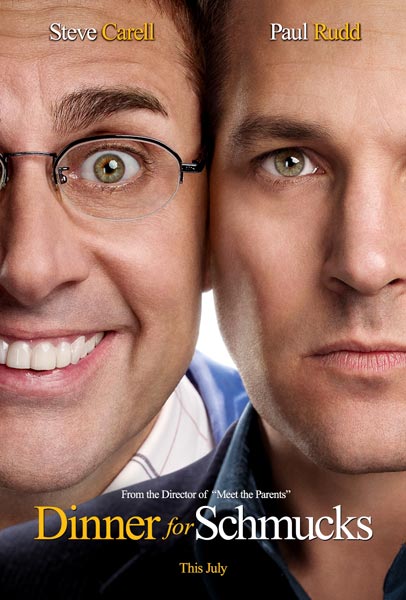
Dinner for Schmucks (4 out of 5)
The set-up for the film is borrowed from the 1998 French comedy The Dinner Game in which a sixth floor analyst, knowing there is a vacancy in the company, comes up with a brilliant idea to woo a hundred million dollar client their way. However the boss (Bruce Greenwood) wants to get to know Tim (Paul Rudd, playing the straight man) a little better before giving him the new office and invites him to the monthly company dinner.
The object of the dinner is for each employee to go out into the world and find someone of very “special” talents which, without the quotations, translates into stupid. Tim, by strange coincidence runs into Barry (Steve Carell) who is, among other things, a very “special” kind of guy. Barry is an IRS man who, in his spare time, combs the streets looking for dead mice that he can stuff and dress up and put into scenes that he can photograph and make models out of. When Tim meets him his latest Mousterpiece involves recreating The Last Supper down to the very last beard.
Not impressed is Tim’s girlfriend Julie (Stephanie Szostak) who owns an art gallery and is working with the devilishly pretentious artist Kieran (Flight of the Concord’s Jemaine Clement) who explains to Tim his philosophies on the beauty of living with goats and would be considered a very "special" kind of guy where he not, ya know, famous.
Also amongst the collection of colour is Barry’s boss Therman (Zack Galifianakis) who believes that he can control people’s minds, reminding of what Socrates said about how orators can convince a group of people more about medicine than a doctor, assuming all of those people knew nothing of medicine to begin with.
If the plot sounds crass, well, in a way it is. But it works because Clement, Galifianakis and especially Carell play the characters not only high, but straight as well. It’s obvious that all of these men are exaggerations of comic types so, when it comes time to sit back, during the dinner and watch them be mocked, it is, not quite okay, but acceptable in a funny kind of way.
However, as many comedies find out, to go over-the-topic is not something many do with grace. Caricature is, after all, mostly poor man’s satire but here it’s played completely straight. The worst comedies are the ones that try desperately to be funny. They nudge the audience along with them. Carell is maybe one of the best men there is at playing exceptionally dumb men who never manage to look the part.
Because Carell actually plays Barry as a character you kind of grow to like the poor bum. Sure he’s about as swift as a rock and turns everything he involves himself with into complete devastation but he means well and generally does care, which leads to some tender moments that a lesser comedy probably wouldn’t be bothered with. Barry, in his own special way, has the kind of naive innocence that made Chaplin’s the Tramp one of the cinema’s most beloved characters.
That’s the secret to great comedy and why Dinner for Schmucks works. Were it to ever let on to the audience that it were trying to be funny it would be crass and dumb. Instead it shoots straight and builds characters that, despite it all, you grow to like and root for on the way to the inevitable conclusion where Tim realizes that, if this is the cost of doing business, maybe he’s in the wrong one. Anyone can act like an idiot and pass it off as comedy. Real comedy is about people who, despite everything else, just so happen to be a few cards short of a whole deck.
Because Carell actually plays Barry as a character you kind of grow to like the poor bum. Sure he’s about as swift as a rock and turns everything he involves himself with into complete devastation but he means well and generally does care, which leads to some tender moments that a lesser comedy probably wouldn’t be bothered with. Barry, in his own special way, has the kind of naive innocence that made Chaplin’s the Tramp one of the cinema’s most beloved characters.
That’s the secret to great comedy and why Dinner for Schmucks works. Were it to ever let on to the audience that it were trying to be funny it would be crass and dumb. Instead it shoots straight and builds characters that, despite it all, you grow to like and root for on the way to the inevitable conclusion where Tim realizes that, if this is the cost of doing business, maybe he’s in the wrong one. Anyone can act like an idiot and pass it off as comedy. Real comedy is about people who, despite everything else, just so happen to be a few cards short of a whole deck.
Subscribe to:
Posts (Atom)