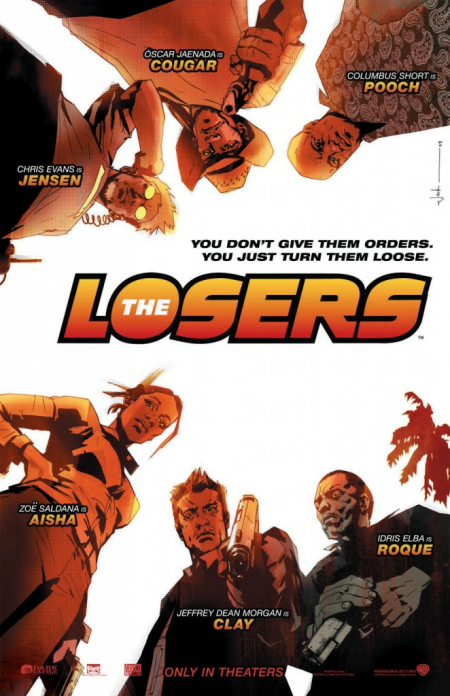
The Losers is based on a comic book but it looks and feels more like an action movie. It’s big, loud, violent and dumb. God bless it. It recalls a time when action movies were allowed to be fun. Remember that? When they were just as much about personality as they were action, which The Losers has plenty of regardless? It has running, jumping, fighting, shooting, and, gasp, explosions that are created through the combination of gasoline, heat and oxygen, not a mouse and a keyboard. Remember that too? The Losers doesn’t go so far as to give rebirth to the classic days of the action hero, but it does manage to wrestle the genre away from the high tech, artificial flashes of light, sound and colour that have become a mainstay as of late and give it back to the characters who occupy it. Hey, it’s a start.
The Losers are a group of skilled military men, employed by the CIA to, oh I donno, ki
 ll bad guys. But when a mission is botched by an evil insider who goes by the name Max, the group pretends they are dead and set up shop in Bolivia where they hide away and live their new life. The team is made up of the leader Clay (Jeffery Dean Morgan), the tech guy Jensen (Chris Evans), the knife guy Roque (Idris Elba), the bomb guy Pooch (Columbus Short) and the marksman Cougar (Oscar Jaenada).
The team are getting along and getting by but deep down Clay wants to find Max and take him out for blowing up 25 innocent kids with a missile that was meant for him and his team. Max, it might as well be stated, when he finally appears, is played by one-time heartthrob turned character actor Jason Patrick who manages the wonderful feat of creating a completely original villain just through the nature of his presence. A lesser actor would have flown way over-the-top in the same role but Patrick always keeps both feet on the ground. He’s so good at creating evil men that he takes the role one step further into comedy instead making him both A) the film’s most amusing character and B) all the more shocking when his violence suddenly erupts.
Into the mix comes Aisha (Avatar’s Zoe Saladana) who hunts The Losers down in Boliva and is first mistaken for a foe so that, oh I donno, the film can justify burning down a hotel room. Fair enough. Turns out Aisha has one concern: killing Max. Why she wants to is unknown to the group but hey, she’ll cop the tab and they get their names cleared. Sounds good.
That’s the plot, th e rest is all attitude. It’s kind of funny, kind of exciting, and all around, you know, kind of enjoyable in its glee for pulling out all of the stops for no better reason than to pull out all the stops. You’ve got to admire that. Action movies have been so mindless and hollow for so long that you’ve got to flag the ones with good senses about themselves. There’s a scene towards the end, during the big final shoot-out between Max and The Losers where a motorcycle becomes the prop at the centre of a wonderful action sequence. Many people who value their hearts and their minds will take issue with this. They’ll call it ridiculous. I don’t know, I call it kind of inspired because for one, there’s a certain danger, and therefore excitement, in ramping a motorbike off a high incline, second, motorbikes represent speed and speed somehow always translates into excitement and third, it’s something original. Good action movies take a certain degree of creativity to pull off successfully. The Losers has it to spare.
Maybe that has something to do with the script, which was written by that valuable subverter of genres Peter Berg whose own The Rundown was another staple of action filmmaking of the highest order. Heck, it may have been the last great Hollywood action movie. Here, like there, Berg creates actual characters out of personality types which is then elevated into fruition by the actors, while director Sylvain White goes into hyper-stylist overdrive trying to make everything look as delicious and exciting as possible. Sure, it’s trash, but it’s good trash and you know what Pauline Kael said: if we can’t enjoy good trash, why bother going to the movies in the first place?
Into the mix comes Aisha (Avatar’s Zoe Saladana) who hunts The Losers down in Boliva and is first mistaken for a foe so that, oh I donno, the film can justify burning down a hotel room. Fair enough. Turns out Aisha has one concern: killing Max. Why she wants to is unknown to the group but hey, she’ll cop the tab and they get their names cleared. Sounds good.
That’s the plot, th
 e rest is all attitude. It’s kind of funny, kind of exciting, and all around, you know, kind of enjoyable in its glee for pulling out all of the stops for no better reason than to pull out all the stops. You’ve got to admire that. Action movies have been so mindless and hollow for so long that you’ve got to flag the ones with good senses about themselves. There’s a scene towards the end, during the big final shoot-out between Max and The Losers where a motorcycle becomes the prop at the centre of a wonderful action sequence. Many people who value their hearts and their minds will take issue with this. They’ll call it ridiculous. I don’t know, I call it kind of inspired because for one, there’s a certain danger, and therefore excitement, in ramping a motorbike off a high incline, second, motorbikes represent speed and speed somehow always translates into excitement and third, it’s something original. Good action movies take a certain degree of creativity to pull off successfully. The Losers has it to spare.
Maybe that has something to do with the script, which was written by that valuable subverter of genres Peter Berg whose own The Rundown was another staple of action filmmaking of the highest order. Heck, it may have been the last great Hollywood action movie. Here, like there, Berg creates actual characters out of personality types which is then elevated into fruition by the actors, while director Sylvain White goes into hyper-stylist overdrive trying to make everything look as delicious and exciting as possible. Sure, it’s trash, but it’s good trash and you know what Pauline Kael said: if we can’t enjoy good trash, why bother going to the movies in the first place?


